Will geopolitics derail electricity price falls?

Aerial view of an LNG tanker docked at a coastal industrial facility with distinctive spherical storage tanks and infrastructure for natural gas.

Overview

On 19 March 2026, the Australian Energy Regulator (AER) released its Draft Default Market Offer (DMO) determination for the 2026–27 regulatory year. The Draft DMO proposes electricity price reductions across all DMO regions (NSW, Southeast QLD, SA). The DMO establishes a regulated price cap for standing offer electricity plans and serves as a benchmark reference price for market offers. It is designed to provide a safety net for households and small business customers who do not actively switch electricity retailers.

Under the Draft determination, residential customers are forecast to experience annual price reductions of between 1.3% and 10.1%, while small business customers could see larger reductions ranging from 7.6% to 21.2%, depending on region and distribution network. These reductions are primarily driven by lower wholesale electricity costs (WEC).

Wholesale Electricity Costs and DMO Methodology

Wholesale electricity costs are a key component of the DMO and are calculated using a complex methodology. In simplified terms, the WEC reflects a volume-weighted average of ASX Energy contract prices. As WEC typically represents approximately 30–40% of the final DMO, changes in forward contract prices can materially influence regulated electricity prices.

Lessons from the 2022 DMO Volatility

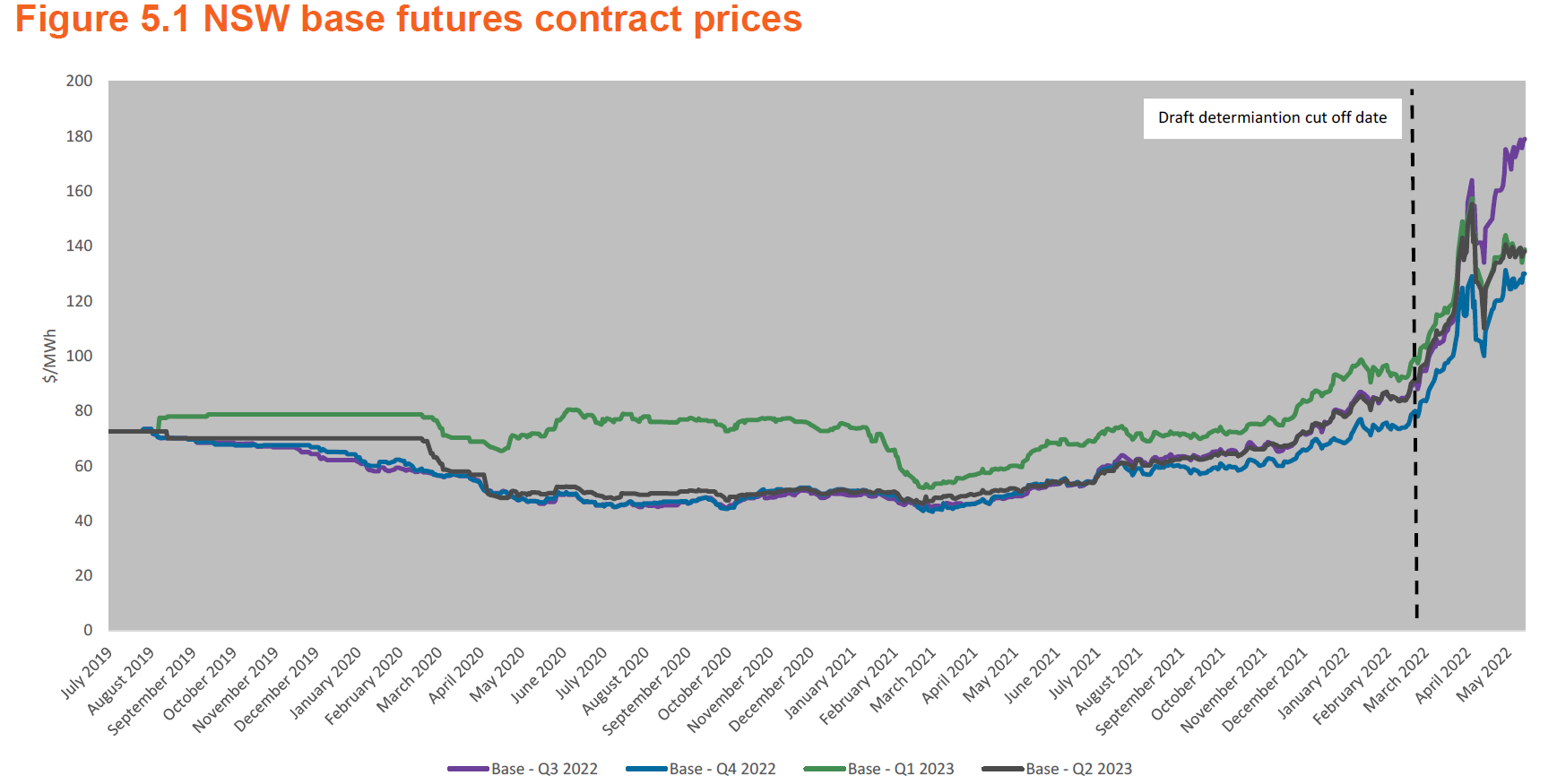
Historical experience demonstrates the sensitivity of the DMO to rapid changes in energy contract prices. In 2022, a sharp increase in futures contract prices—approximately 100% between the Draft DMO release in February and the Final DMO determination in May—was largely triggered by the war in Ukraine. This resulted in a significant uplift in WEC, with increases of ~25% in QLD and NSW, and ~5% in SA.

The table below illustrates the extent of these changes in 2022 for flat-rate tariffs across key distribution networks:

Distribution Network Draft WEC ($/MWh) Final WEC ($/MWh) Change
Ausgrid 97.94 122.23 25%
Endeavour 98.94 124.25 26%
Essential 91.53 115.97 27%
Energex 92.47 110.53 20%
SAPN 128.26 134.53 5%


Current Market Conditions and the Iran Conflict

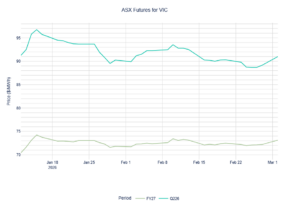
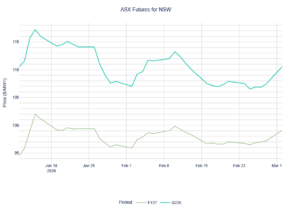
Baseload quarterly contracts for FY27 remained broadly stable throughout most of 2025 and declined steadily between November 2025 and February 2026. However, following the US–Iran conflict on 28 February 2026, contract prices across these three states have increased by ~10–20%.

This development raises the question of whether current geopolitical tensions could result in a similar divergence between the Draft and Final DMO outcomes as observed in 2022.

Expected Impact on the Final 2026–27 DMO

Analysis conducted by Edge2020, drawing on historical Draft versus Final DMO outcomes and movements in contract prices, suggests that if forward prices for FY27 remain at current levels, the impact on the Final DMO is likely to be minimal.

In a more extreme scenario—where contract prices rise rapidly over the next two months in a manner comparable to 2022—the WEC component could increase by up to 7%. However, such an outcome is considered highly unlikely due to stronger coal fleet availability, softer fuel prices, and increased renewable generation and storage capacity in the market. Even in this scenario, the overall impact on final DMO prices would be moderated, given the partial contribution of WEC to total DMO costs.

Longer-Term Implications

While the immediate impact on the 2026–27 Final DMO is expected to be limited, sustained higher forward contract prices would eventually feed into future DMO determinations. As a result, prolonged geopolitical instability and persistently elevated energy prices could place upward pressure on regulated electricity prices in subsequent years.

 

Strait of Hormuz Closure Triggers Global LNG Shockwaves

Escalating Middle East conflict halts Qatari LNG exports, tightening global gas markets and driving renewed volatility in Australian electricity futures.

The escalating war in the Middle East has forced the world’s second largest liquefied natural gas (LNG) producer, Qatar, to halt operations. At the centre of this disruption is the Strait of Hormuz — one of the world’s most critical maritime trade routes for oil and LNG.

Iran has reportedly warned shipping not to traverse the Strait, and tanker traffic through the waterway has effectively ceased for the time being. This closure presents a significant risk of disruption to global oil and LNG markets, at a time when supply balances remain sensitive.

A Major Shock to Global LNG Supply

According to Wood Mackenzie, nearly 20% of global LNG transited the Strait of Hormuz in 2025. A halt in flows through this corridor would dramatically tighten global LNG markets and place immediate upward pressure on prices.

In addition, Woodmac has warned that the scale of disruption could be “comparable in scale to the curtailment of Russian gas supplies to Europe four years ago” — an event that triggered extreme volatility and sustained price increases across global energy markets.

With Qatar halting operations and vessel traffic paused, the market is now pricing in the risk of extended supply disruption.

Flow-On Impacts for Australia

Australia is not insulated from these global dynamics. Domestic gas and electricity prices are strongly correlated with international LNG markets, meaning sustained disruption is likely to influence local pricing.

This week, electricity futures have already begun responding:

  • NSW Q2 2026 futures rose 6.58% week-on-week

  • VIC Q2 2026 futures rose 6.57% week-on-week


An extended conflict or prolonged supply interruption could reverse the downward trend seen in electricity futures over recent months, increasing cost pressure for energy users.

A Rapidly Evolving Situation

This is a fast-moving geopolitical and energy market event. The duration of the disruption — and whether LNG flows resume in the near term — will be critical in determining the magnitude and persistence of price impacts.

We are closely monitoring developments across global LNG markets and Australian electricity futures.

If you’re interested in how this escalating situation might impact your electricity cost, please contact us.

AEMC Confirms Higher Market Price Cap for FY27, with the Cumulative Price Threshold to Rise from July 2026

AEMC Publishes their Increase to NEM Reliability Settings for FY27

On 26 February, the Australian Energy Market Commission (AEMC) published its annual update to the National Electricity Market’s (NEM) reliability settings, confirming that the Market Price Cap (MPC) will rise from $20,300/MWh in FY26 to $23,200/MWh for FY27.

The Cumulative Price Threshold (CPT) will also increase to $2,225,900/MWh from 1 July 2026.

What Do These Changes Mean?

The Market Price Cap (MPC) is the maximum price that can be reached on the spot market during any dispatch and trading interval.

The Cumulative Price Threshold (CPT) is a safeguard mechanism. It acts as a trigger to end a sustained seven-day period of extremely high prices in the wholesale electricity market.

Under the new settings, the CPT will be breached if:

  • The spot price reaches the MPC for 96 five-minute intervals (8 hours), or

  • The spot price averages $1,104/MWh over a week,

When this occurs, the Administered Price Cap (APC) is triggered, capping wholesale electricity prices at $600/MWh. The APC remains in place for subsequent days if the CPT continues to be exceeded.

Why These Settings Matter

The NEM is an energy-only market, meaning generators are paid only for the electricity they produce, not for maintaining available capacity.

These price settings — which remain the highest price caps in the world — have no impact on wholesale electricity prices more than 99% of the time. However, they play a critical role during periods of tight supply by:

  • Encouraging additional generation into the market

  • Supporting system reliability during supply shortages

  • Providing incentives for investment in dispatchable capacity

In short, the MPC and CPT settings are designed to ensure supply is available when the system needs it most.

Risk Implications for Spot-Exposed Consumers

While high-price events are infrequent, their impact can be material.

Under the new MPC, a single five-minute interval at the MPC can increase the quarterly average spot price by approximately $0.90/MWh. This presents a meaningful risk for consumers exposed to spot pricing.

So far in FY26, the spot price has reached the MPC:

  • 6 times in NSW

  • 5 times in South Australia

  • 2 times in Tasmania

As volatility events become more common during periods of system stress, understanding exposure to high-price risk remains critical for energy users.

If you’d like to gain insight into how you can manage volatility under the new settings, please get in touch with our team at Edge2020.