
NSW Budget 2026 Signals Acceleration in Energy Transition

Major investment in renewable zones, transmission infrastructure, and household electrification signals a rapidly evolving energy market.

The New South Wales Government’s 2026 Budget, released on 23 June 2026, reinforces a strong and coordinated push toward a cleaner, more decentralised energy system. With significant funding directed toward Renewable Energy Zones (REZs), transmission infrastructure, and household electrification, the budget highlights a dual-track strategy shaping the future of the state’s energy market.


Major Investment in Renewable Energy Zones

REZs remain central to NSW’s energy transition strategy, with the Government continuing to support their delivery and expansion. These zones are expected to unlock approximately $77 billion in private investment, positioning them as a cornerstone of future renewable generation capacity.

Key projects such as the Central-West Orana REZ, New England REZ, and Hunter Transmission Project are progressing, reinforcing NSW’s commitment to developing large-scale renewable infrastructure.


Transmission Infrastructure a Key Priority

A critical focus in this year’s budget is ensuring that new generation can be effectively delivered to market. The Government has allocated $2.5 billion over four years to the Transmission Acceleration Facility, designed to fund early-stage development costs, including community engagement and workforce mobilisation.

Importantly, the facility operates as a recycling fund, with costs recovered from private transmission operators over time, allowing funding to be reinvested in future projects. Repayments are expected to continue through to 2040.

In addition, $224.8 million has been committed to the South West Renewable Energy Zone, supporting the delivery of up to 2.5 gigawatts of network transfer capacity.


Strong Focus on Household Energy Upgrades

Alongside large-scale infrastructure, the budget places considerable emphasis on reducing energy costs and emissions at the household level.

A $557.1 million package has been introduced to support energy upgrades, including:

  • Rooftop solar systems
  • Battery storage
  • Insulation and draught-proofing
  • Reverse-cycle air conditioning
  • Electrical and switchboard upgrades

The program includes:

  • $480 million in interest-free loans, up to $15,000 per household (repayable over 10 years)
  • $77.1 million in direct discounts
  • Eligibility for households with combined incomes up to $210,000

Additional initiatives, such as appliance upgrade programs, further aim to improve household energy efficiency and reduce long-term costs.


Growth in Distributed Energy and Storage

The budget also builds on the growing role of distributed energy resources. Incentives include:

  • Approximately 30% reduction in upfront costs for small-scale battery systems through the Cheaper Home Batteries program (administered by the Australian Government)
  • Virtual Power Plant (VPP) incentives, offering households average savings of up to $500

These measures are designed to encourage households to play a more active role in the energy system, contributing to grid stability while reducing reliance on traditional generation.


A More Complex Energy Landscape

From Edge2020’s perspective, the 2026 NSW Budget confirms a clear trajectory:

  • Increased renewable penetration
  • Expanded transmission capacity
  • Greater participation from end users

While these developments create opportunities, they also introduce greater complexity in pricing, contract structures, and risk management.

As the energy market evolves, businesses and asset owners will need to adopt more strategic approaches to energy procurement and management to navigate increasing volatility and maximise value.


If you’re assessing how these changes may impact your organisation, our team at Edge2020 would love to share insights and help identify commercial and sustainability opportunities in the year ahead.
2026 Integrated System Plan – Energy Transition Roadmap

AEMO has released its 2026 Integrated System Plan (ISP)

The ISP identifies the Optimal Development Pathway (ODP) which AEMO expects to be the lowest-cost path to delivering reliable and secure electricity for consumers whilst supporting government policy and emissions reduction objectives to 2050.

 Key highlights:

Timely investment is critical

  • Timely investment in generation, storage and network infrastructure is critical and the key risk identified in the ISP to achieving the ODP.
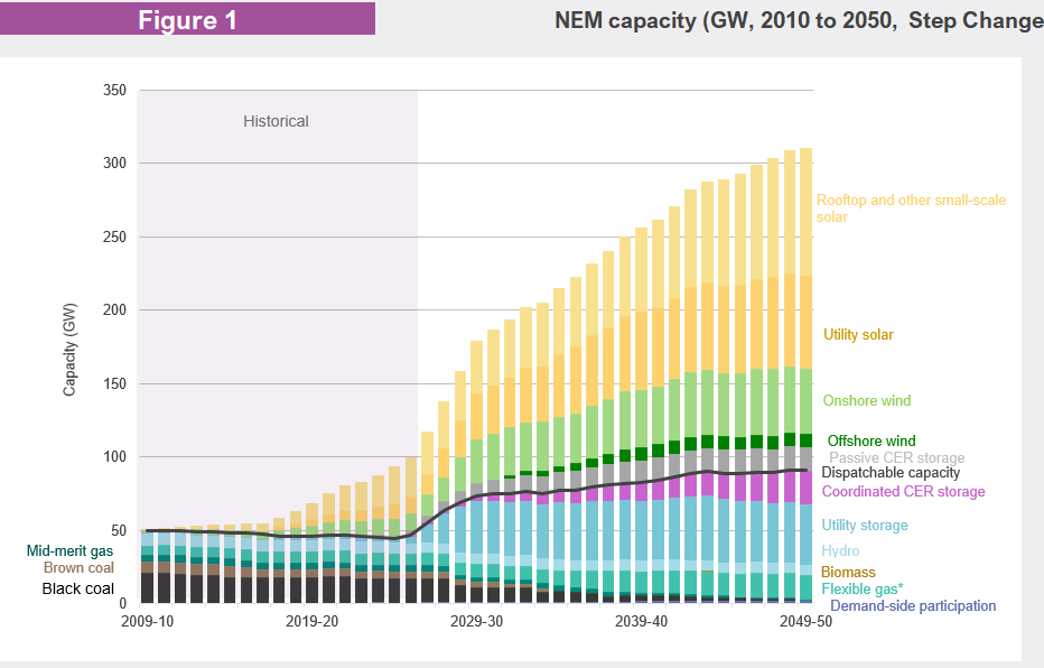
  • AEMO expects $106 billion of investment to 2050 (today’s dollars) will be required under the ODP and most likely Step Change scenario.
  • As a key enabler, the investment includes ~6,000km of new transmission line. This equates to around 14% extension on the existing transmission network.

Growth in CER and the exit of coal

  • AEMO anticipates full retirement of coal fired generation by 2049. In its place, will be a mix of renewables firmed by batteries, pumped hydro and gas.
  • Consumer Energy Resources (CER) will be a key contributor to meeting the ODP. AEMO expects 87GW in rooftop and other small-scale solar will be installed by 2050. Around two-thirds of dwellings with rooftop solar are expected to also have a battery installed by 2050, contributing 35GW. By this time, AEMO also expects 80% of vehicles to be electric.
  • By 2050 and to replace coal generation, 117GW of utility-scale solar and wind (five times current levels) and almost 50GW of utility-scale dispatchable storage and hydro will be required under the ODP to meet AEMO’s forecast demand. In addition, 17GW of flexible gas-fired generation will also be required by 2050 under the ODP.
  • Co-ordination and integration between Consumer and Distributed Energy Resources with the grid is highlighted as a key requirement in the ISP to meeting the ODP with distribution networks playing a key role.

Demand growth

  • While the growth in CER is expected to alleviate some of the pressure on grid-scale infrastructure required, total electricity consumption across the NEM is expected to nearly double by 2050.
  • Demand growth will be led by population growth, electrified processes (as consumers switch from petrol, diesel and gas to electricity), data centres and other new electricity-intensive industries.
  • Recognising the uncertainties around the rapid growth in data centre demand, the ISP Step Change scenario assumes data centres will make up almost 10% of underlying demand by 2050, equivalent of around 20% of today’s grid consumption.

Queensland to continue large investments in energy in new budget

The Queensland 2026-27 budget was released today with the following key new investments in energy:

Locking-in lower power prices for Ergon customers as part of the Energy Roadmap Price Drop, saving families around 7% and businesses 8% by passing on the full power price reduction.

Delivering the Fuel Security Plan by fast-tracking the Taroom Trough Development Plan, accelerating the development of production in the Taroom Trough, optimising production in the Cooper-Eromanga Basin, and investing in new refining capability on Queensland soil with $19 million over two years.

Boosting Queensland’s onshore fuel storage capacity by unlocking land near ports and fast-tracking new investment, including unlocking up to $100 million investment by BP in additional fuel storage.

Continuing the rollout of the $5.2 billion Energy Roadmap in 2026-27. Key investments include:

  • $2.096 billion to maintain and extend the electricity network including $420 million to progress CopperString (with construction to commence on the Eastern Link in 2028 and commercial operations in 2032 (subject to approvals)) and $501.1 million to progress Powerlink’s Gladstone Project.
  • The Electricity Maintenance Guarantee will support a further $523.5 million of investment into existing state-owned generation assets. Over the next five years, the Electricity Maintenance Guarantee is underpinning a $1.8 billion investment in Queensland’s state-owned generation assets.
  • Queensland Hydro will invest $324.3 million to continue early works and progress the Borumba Pumped Hydro Energy Storage as part of a joint energy and water security project, subject to ongoing assessment through the Queensland Investment Corporation (QIC) Review.
  • The $200 million North West Energy Fund is backing new energy projects in and around Mount Isa, Cloncurry, Julia Creek and Richmond.

Further details can be found in Budget Paper 3 – Capital Statement. Interested in learning more about these new announcements? Please get in touch with our energy experts at Edge2020.