Strait of Hormuz Closure Triggers Global LNG Shockwaves

Escalating Middle East conflict halts Qatari LNG exports, tightening global gas markets and driving renewed volatility in Australian electricity futures.

The escalating war in the Middle East has forced the world’s second largest liquefied natural gas (LNG) producer, Qatar, to halt operations. At the centre of this disruption is the Strait of Hormuz — one of the world’s most critical maritime trade routes for oil and LNG.

Iran has reportedly warned shipping not to traverse the Strait, and tanker traffic through the waterway has effectively ceased for the time being. This closure presents a significant risk of disruption to global oil and LNG markets, at a time when supply balances remain sensitive.

A Major Shock to Global LNG Supply

According to Wood Mackenzie, nearly 20% of global LNG transited the Strait of Hormuz in 2025. A halt in flows through this corridor would dramatically tighten global LNG markets and place immediate upward pressure on prices.

In addition, Woodmac has warned that the scale of disruption could be “comparable in scale to the curtailment of Russian gas supplies to Europe four years ago” — an event that triggered extreme volatility and sustained price increases across global energy markets.

With Qatar halting operations and vessel traffic paused, the market is now pricing in the risk of extended supply disruption.

Flow-On Impacts for Australia

Australia is not insulated from these global dynamics. Domestic gas and electricity prices are strongly correlated with international LNG markets, meaning sustained disruption is likely to influence local pricing.

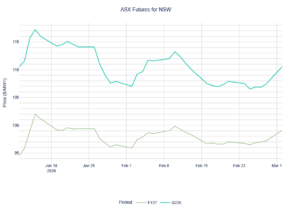
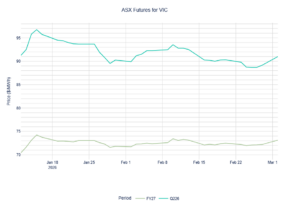
This week, electricity futures have already begun responding:

  • NSW Q2 2026 futures rose 6.58% week-on-week

  • VIC Q2 2026 futures rose 6.57% week-on-week


An extended conflict or prolonged supply interruption could reverse the downward trend seen in electricity futures over recent months, increasing cost pressure for energy users.

A Rapidly Evolving Situation

This is a fast-moving geopolitical and energy market event. The duration of the disruption — and whether LNG flows resume in the near term — will be critical in determining the magnitude and persistence of price impacts.

We are closely monitoring developments across global LNG markets and Australian electricity futures.

If you’re interested in how this escalating situation might impact your electricity cost, please contact us.

AEMC Confirms Higher Market Price Cap for FY27, with the Cumulative Price Threshold to Rise from July 2026

AEMC Publishes their Increase to NEM Reliability Settings for FY27

On 26 February, the Australian Energy Market Commission (AEMC) published its annual update to the National Electricity Market’s (NEM) reliability settings, confirming that the Market Price Cap (MPC) will rise from $20,300/MWh in FY26 to $23,200/MWh for FY27.

The Cumulative Price Threshold (CPT) will also increase to $2,225,900/MWh from 1 July 2026.

What Do These Changes Mean?

The Market Price Cap (MPC) is the maximum price that can be reached on the spot market during any dispatch and trading interval.

The Cumulative Price Threshold (CPT) is a safeguard mechanism. It acts as a trigger to end a sustained seven-day period of extremely high prices in the wholesale electricity market.

Under the new settings, the CPT will be breached if:

  • The spot price reaches the MPC for 96 five-minute intervals (8 hours), or

  • The spot price averages $1,104/MWh over a week,

When this occurs, the Administered Price Cap (APC) is triggered, capping wholesale electricity prices at $600/MWh. The APC remains in place for subsequent days if the CPT continues to be exceeded.

Why These Settings Matter

The NEM is an energy-only market, meaning generators are paid only for the electricity they produce, not for maintaining available capacity.

These price settings — which remain the highest price caps in the world — have no impact on wholesale electricity prices more than 99% of the time. However, they play a critical role during periods of tight supply by:

  • Encouraging additional generation into the market

  • Supporting system reliability during supply shortages

  • Providing incentives for investment in dispatchable capacity

In short, the MPC and CPT settings are designed to ensure supply is available when the system needs it most.

Risk Implications for Spot-Exposed Consumers

While high-price events are infrequent, their impact can be material.

Under the new MPC, a single five-minute interval at the MPC can increase the quarterly average spot price by approximately $0.90/MWh. This presents a meaningful risk for consumers exposed to spot pricing.

So far in FY26, the spot price has reached the MPC:

  • 6 times in NSW

  • 5 times in South Australia

  • 2 times in Tasmania

As volatility events become more common during periods of system stress, understanding exposure to high-price risk remains critical for energy users.

If you’d like to gain insight into how you can manage volatility under the new settings, please get in touch with our team at Edge2020.

The AER’s NSW Electricity Infrastructure Roadmap Contributions Rise Again

A breakdown of the 2026–27 contribution determination and how rising network and scheme charges are flowing through to NSW electricity bills.

On 11 February 2026, the Australian Energy Regulator (AER) released its contribution determination for cost recovery under the NSW Electricity Infrastructure Roadmap for the 2026–27 financial year, in accordance with the NSW Electricity Infrastructure Investment Act 2020.

These annual costs are passed through by the three NSW distribution network service providers (DNSPs) to NSW consumers as part of the network component of electricity bills.

The total contribution determination for 2026–27 is $593.16 million.

The amounts required to be paid by each NSW distribution network service provider (DNSP) are:

  • Ausgrid: $254.23m

  • Endeavour Energy: $221.40m

  • Essential Energy: $117.53m

These contributions have increased significantly over recent years. And for many customers, these scheme-related costs are becoming a more noticeable driver of network charges.

For context: between FY25 and FY26, flat tariffs for small business customers increased by:

  • Ausgrid: 9.6%

  • Endeavour Energy: 9.5%

  • Essential Energy: 7.9%

Notably, almost half of this increase was driven by additional transmission and jurisdictional scheme costs — including NSW Roadmap costs.

If you would like to understand what this means for your organisation’s electricity costs, please reach out to the Edge2020 team. 

Quorn Park signals a new era of hybrid solar-BESS projects

A case study showing how hybrids can boost commercial results and improve system performance as the NEM evolves.

Located near Parkes, NSW, Quorn Park combines 98 MWdc/80 MWac of solar with a 20 MW two-hour battery behind a single connection point as the NEM’s first large-scale hybrid to connect under one Generator Performance Standard (GPS).

We’re heading into a ‘Wave of 2026’ – around 4-6 projects that reached financial close in 2024/25 are expected to start commissioning this year using the single-GPS model. Nearly all new applications for combined solar and battery sites (15+ projects) are now opting for the single GPS model, signalling that it is quickly becoming the new normal.

Historically, if you had a solar farm and a battery at the same location, AEMO treated them as two completely separate machines with two different sets of instructions. Quorn Park is one of the first projects to utilize the Aggregated Dispatch Conformance (ADC) rules, which treat the whole facility as a single “black box” at the connection point. That “true hybrid” approach delivers three big advantages:

1. More valuable energy from the same assets: By storing solar during high-generation periods and dispatching later, the battery helps firm output and shift energy into higher-value intervals. It reduces bidding complexity and also opens the door to revenue stacking, including participation in services like FCAS, improving overall project economics.

2. Better grid outcomes and dispatch alignment: A key operational benefit is tighter conformance with AEMO dispatch targets through Aggregated Dispatch Conformance (ADC) under the IESS reforms. In practice, the battery can respond rapidly to smooth variability and maintain a near-perfect conformance record – supporting grid stability and reducing the risk of performance penalties.

3. Lower duplication and a clearer connection pathway: Because the solar and battery share infrastructure and compliance under a single GPS, the hybrid design can reduce duplicated equipment, streamline approvals and improve cost efficiency versus separate connection approaches.

Now energised and in commissioning/testing, Quorn Park is targeting full operation in H1 2026 – and it’s a useful case study for how hybrids can improve both commercial performance and system outcomes as the NEM evolves.

At Edge2020, we’re committed to keeping you informed about energy market trends and changes that may impact your business. If you’re interested in understanding how this particular trend could affect your organisation, please get in touch with us.