
STATE OF THE ELECTRICITY MARKET – WINTER MARKET OVERVIEW

Alex Driscoll, Manager Wholesale Clients and Markets

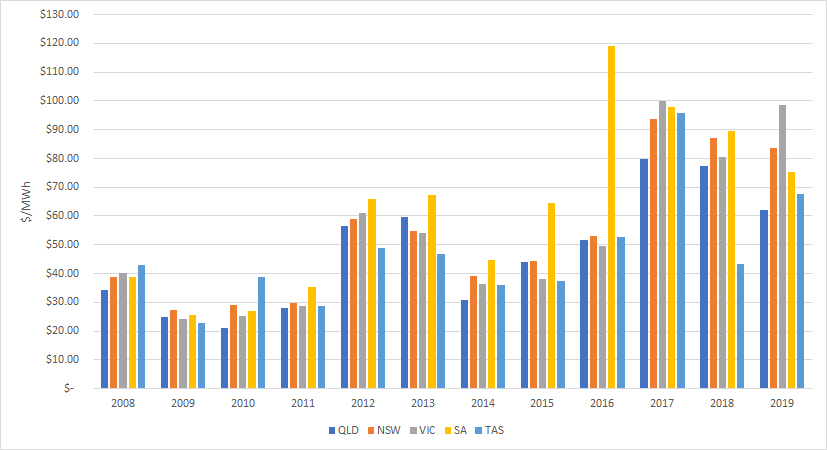
Electricity spot prices in Q319 (July to September) were relatively in line with Q3 2017 and 2018, however much higher than prices seen from 2014 to 2016 inclusive. Although, Q319 prices were softer than any other quarter for the year (2019) in majority of the NEM regions. The past three months have seen multiple negative price events in SA and QLD due to mild demand, constrained interconnectors and strong renewable generation volumes in solar (rooftop PV and large scale) and wind.

SA’s Q319 price is on a downward trajectory from the massive jump-up it experienced in 2016, taking with it NSW and QLD which both had lower Q319’s in comparison to the last 2 years. Whilst VIC and Tasmania’s Q319 regained in price post a slump in Q318.


Figure 1: Historical prices for autumn
(Source: AEMO)

Throughout Q319 both QLD and SA experienced multiple negative price events and settlement periods. These events in QLD were lead by a combination of transmission line works on the QNI restricting its flow into NSW, low demand, strong solar rooftop PV and large-scale solar generation and interesting bidding behavior by QLD thermal generation.. Fuelling the low and negative price events was market participant bidding behaviour. It can be seen in the bid stacks, that around mid-August 2019, Stanwell Corp shifted an additional ~500 MW of generation to a bid band of < $0/MWh, leaving a good 3,000 MW exposed to prices less than $0/MWh. On a mild demand day in QLD with strong Rooftop PV, operational demand is lucky to reach 5,000 MW; add QNI in at 1,000 MW and the result is Stanwell bidding half of QLD demand + QNI at below $0/MWh.

SA’s multiple negative price events were also due to transmission line constraints restricting flows into VIC, and soft operational demand which was impacted significantly by strong solar rooftop PV and strong wind generation figures with an average volume of 600 MW. There were multiple weekends which resulted in several hours per day of negative pricing with Friday the 27th of September resulting in ~11.5 hours of negative half hourly pricing. The strong wind generation levels also meant AEMO had to issue directions to Pelican Point and Osborne gas fired power stations multiple times throughout the quarter for grid stability.

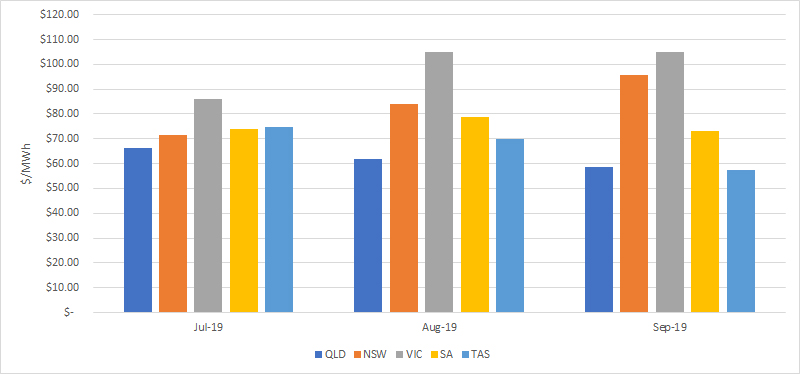
VIC and NSW prices across Q319 were both lifted by the Basslink outage which occurred on the 24th of August and lasted through to the 29th of September, resulting in no flows across the Basslink interconnector in either direction. During this time, VIC was heavily reliant on megawatts from NSW particularly during periods of low wind generation, whilst both regions were struggling with ailing baseload thermal plant issues and maintenance which was planned for the yearly shoulder period. The flip side of this?  Tas was spared from the high price spikes experienced in VIC during this time which lead to a softened Q3 and September spot price for the region.

Figure 2: Average monthly spot prices in the NEM
(Source: AEMO)

Water levels at Snowy Hydro continued to increase at Lake Eucumbene over the quarter with levels now sitting at ~28.81 %, which is above the levels recorded the same time last year. The increased inflow of water volumes lead to a higher spill rate from Snow Hydro at Tumut, Upper Tumut (both NSW) and Murray (VIC) hydro plants. Additionally, issues with baseload thermal plant particularly in NSW and VIC lead to multiple gas peaking plants running to cover generation gaps at a higher price (due to higher cost of fuel).

Tas Hydro was able to conserve a fair amount of water in their dams over the period of the Basslink outage with storage volumes higher than they were a year prior, leading into the warmer months and Summer of 2019/2020.

With the increase in invoked constraints in QLD both inter and intra-regionally, QLD’s experienced 2 x five-minute VoLL spikes on the morning Wednesday 25th September. These VoLL spikes of $14,000/MWh and $13,998/MWh however were not so much due to market participant bidding or reflective of a market supply and demand squeeze, rather they were caused by both inter and intra-regional transmission constraints and limits imposed by AEMO. Transmission work was being carried out on lines impacting the QNI, forcing it to flow into NSW, whilst the QLD Central to Southern constraint was imposed, winding back generation north of Gladstone and Calvale. This meant that there was not sufficient enough generation in central QLD to satisfy demand, resulting in the bid stack climbing to $14,000/MWh to trigger multiple gas peakers and Wivenhoe who all reside south of Gladstone.

Also in this quarter we saw the release of AEMO’s 2019 ESOO which called out some imminent concerns for Summer:

  • Forecasted tightly balanced supply and demand in several regions heading into Summer 2019/20, with VIC the only region forecasting an elevated risk of expected unserved energy (USE) currently not exceeding the 0.002% threshold (at 0.0026%).
  • Potential risk to Summer 2019/20 if the Loy Yang A2 and Mortlake 2 remain on outage during the Summer period; AEMO are predicting 60% chance VIC’s Mortlake won’t be back for Summer 2020 and 30% AGL’s Loy Yang A2 won’t be back in time either.
  • AEMO currently working to secure the maximum permissible reserves via the Reliability and Emergency Reserve Trader (RERT) to ensure Victoria’s reliability of supply meets the reliability standard for this summer.

The above lead to a rally in the futures curves particularly in Q419 and Q120 in VIC, SA, NSW and Tas.  These are all regions that would feel the pinch of tightly balanced supply and demand with thermal baseload plant in the two major regions, NSW and VIC currently experiencing reliability issues. At this stage, MTPASA and market intel depicts that both Loy Yang A2 and Mortlake 2 will be online mid to late December 2019 just in time for Summer.

Looking Forward:

Figure 3: Calendar year 2020 forward contracts 

$/MWh NSW QLD SA VIC TAS
08-Oct-19  $    88.81  $    72.67  $    99.90  $  103.09  $    98.13

(Source: ASX)

The BoM is predicting a warmer than average Spring/Summer which should transpose to greater demand.  This in turn could result in a greater need for supply generally resulting in higher spot prices. This should mean when the sun is beaming in QLD and the wind is howling in SA that the price should remain relatively high, enticing the generators to produce electricity and green certificates which have been a hot commodity in Q319. Despite this, NSW and VIC thermal plant are currently underway preparing for summer in what is generally coined their “summer readiness plan” utilising the shoulder period of the year to prepare plant for the warmer months. Transmission line work is likely to cease as we head into Spring/Summer also.

If you would like to discuss the electricity market outlook and potential impact to your electricity portfolio, please contact our Manager Wholesale Clients and Markets, Alex Driscoll on 07 3905 9220.

Are the physics of MLF elementary ?

At the end of September AEMO announced that it was pushing back its draft Marginal Loss Factor (MLF) determination around rule changes put forward by Adani Renewables to November. 

Now don’t turn off, Marginal Loss Factors are not the new Dan Brown or Stephen King novel, but they are a hot topic of the NEM at the moment and ultimately will affect the cost of the electricity we all buy.  So what are they and why are they important?

What is an Marginal Loss Factor?

Think of a block of flats and you need to fill a bath on the 1st and 10th floors. However, to do that you need to climb up a ladder with a leaky bucket.  Each time you fill the bucket and start climbing the ladder you will have more left in the bucket when you reach the bath on the 1st floor than when you reach the bath on the 10th floor.  Therefore, to fill the bath on the 10th floor, you are required to use more water (and more trips), compared to filling the bath on the 1st floor.

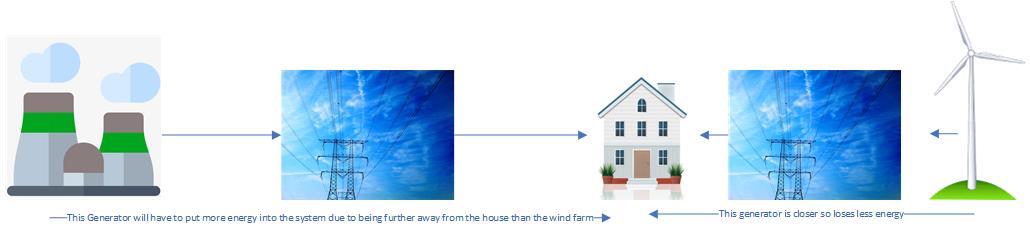
That is exactly what happens on the Electricity networks (Distribution and Transmission networks). The further away your power generation source be it a thermal station, wind or solar farm, is from where you need to use the electricity i.e. our homes and offices, the larger the losses are (the more water that is needed to fill the bath to the same level)

A MLF is a factor given to each power station which represents how much electricity will be lost between the point it is generated and where it is needed. It is “lost” due to the resistance in the high voltage cables increasing and converting some of this power to heat.

But how does that affect energy consumers?  Let’s go back to the bucket for a minute and assume you only need 1 bucket to fill the bath on the first floor but need 10 to fill the bucket on the tenth floor. The company is going to charge you for filling that bucket 10 times (even though it is their leaky bucket and that they only put a tap on the ground floor and not one on the 9th which is causing the problem!) They don’t want to absorb the cost of those losses and affect their profitability, so they pass it through to us. So the bill is more for the person who is on the 10th floor than that of the 1st floor.

It is the same with MLFs, if a station needs to produce twice as much energy to supply a site with electricity due to the MLF, then that cost will be reflected in the sites electricity cost.

AEMO are the calculators of these MLFs and consider the distance from the load centres (Regional Reference Nodes, RRN), the capacity of the current networks, the type of generation (i.e all solar in one area would have relatively similar dispatch patterns) and the new projects coming on in those areas. They then assign each generator their own MLF.

We can’t change physics so why is this news?

So why is this MLF’s a popular topic in the National Electricity Market?

In the past most generation came from large power stations, connected to the transmission network and supplied the main demand “load” centres. This meant that Australia had relatively stable MLF’s and any changes to these factors were negligible. Generators are paid for their bids (to supply the electricity) multiplied by the MLFs, so it affects their cost of generation. Thus, it is important to understand as it affects the costs which are passed through to consumers and for investment decisions for new build generation.

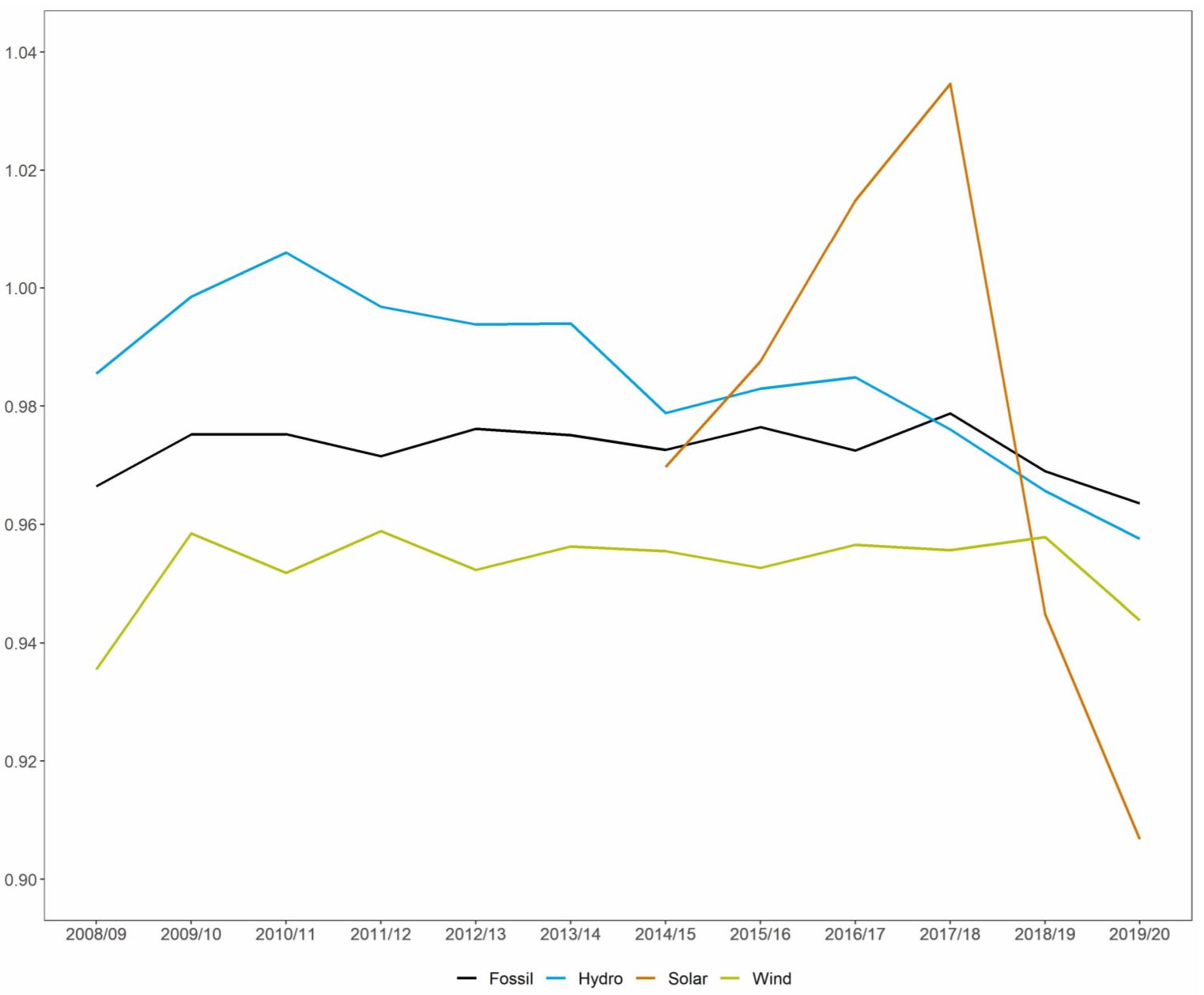
However, we are now in a new world with new types of generation connecting into the network in remote areas and with less predictable dispatch patterns. In many cases these are renewable generation projects which can be built significantly quicker than their thermal counterparts. Reducing the time AEMO have to consider the impact this will have on the network in those areas. This coupled with mothballing of traditional thermal coal units and transmission line constraints has resulted in a significant trend of reduction in the MLFs, which is exacerbated in renewable generation.

Source AEMC TLF Rule

To try and address the reduction in these MLFs there have been many requests by companies requesting that AEMO change their calculation methodology, with Adani Renewables gaining the most traction in their recent request. Adani Renewables have requested that AEMO change the methodology from a site specific MLF to an average loss factor methodology, basically a regional loss factor for an area regardless of generation type. They argue that it would make the market more competitive and result in lower prices. It would also result in more stable MLFs, giving certainty to investors which will drive investment in existing and new renewable projects due to it creating more financial stability.

How am I impacted?

If this is passed, an average MLF could potentially reduce your bill, either directly due to better competition in the areas with high renewables or through a reduction in Transmission charges. However, this relies on the retailer passing these benefits on.

But if this is not adopted there would be two main impacts to consumers.

The first and most obvious is that with reducing MLFs, the cost of generation in high renewable areas could potentially increase and be passed through to end consumers due to inefficiencies in the market, ultimately leading to higher bills.

The second is a twofold impact and is concerning the cost of LGC’s.

As these are being created through generation in the remote and highly constrained areas of the grid and are linked to their allocated MLF, which are the lowest and fastest reducing MLFs. Less would be generated and therefore available and this could increase their value. The second impact is a longer-term view, in that a reducing and uncertainty in renewable MLFs has the potential to significantly reduce direct investment and development in renewables going forward. With ever increasing requirements for these certificates from industry, end users and retail tariffs the continuance of this pattern could set an upward trend in the price of the certificates.

If you would like to know more about MLF’s and the impact on your cost of electricity, please contact Edge Energy Services on 07 3905 9220 or 1800 334 336.

Predicted Shortfall of LGCs for 2019

LGC’s remain relatively elevated at ~$50/certificate. Volumes are being traded whilst liquidity is still being indicated as reasoning for increased prices for CAL19 certificates market.

The Clean Energy Regulator came out on Thursday 31 October and announced based on forecasts and certificates created thus far this year, there is likely to be a shortfall in CAL19 certificate creation by 2 million certificates which has resulted in an uplift in prices.

Despite this, we are seeing continued strong wind and solar generation around the NEM which will continue to have a positive impact on creation levels, with fewer interconnector constraints and transmission constraints intra-regionally impacting energy flows. Tas Hydro’s fleet of run-of-river hydro continues to run hard with a significant volume of water in storage no doubt being reserved for Summer of 2019/2020. Additionally, Snowy Hydro’s water catchment levels also continue to increase leading into Summer.

The Bureau of Meteorology is still predicting a warm and dry Summer 2019/202 which should result in greater demand levels around the NEM allowing for greater generation volumes from renewable sources.

If you would like to know more about the LGC market or need to procure LGC’s for your portfolio, please contact Edge on 07 3905 9220.

STAFF PROFILE – Kate Turner

What is the best piece of advice you have ever received?

The best piece of advice I’ve ever received is to pull a pram on a beach and not try and push it. Less of an issue in England but it is coming into use now I live in Australia.

Name a place you have never been to and would like to visit. Why?

I would love to go to Alaska. I find it fascinating the juxtaposition between big industry and natural resources, versus the sheer rawness of the wilderness and landscape. Plus there are over 100 volcanos and its bear to people ratio is 1:21 – that’s pretty roarsome!

Who or what inspires you?

People who push the boundaries of what is possible. This ranges from the Elon Musk’s of the world who decide that the electrification of vehicles should be happening faster so build their own car company; to Bill Gates who is looking for efficiencies in vaccination programs to try and eradicate Polio. Their minds work in such non-linear ways, which allows them to really think outside of the box. I find it fascinating to follow what they do, how they come up with the ideas and how they deal with any failures along the way.

What is one of the biggest challenges facing energy customers today?

I think the energy industry as a whole, investors, producers and consumers are struggling with a lack of direction from those bodies who set the long term strategic direction. Without this the investment won’t come.  The evolution and integration of large scale renewable can’t progress and the industry will ultimately fail to protect consumers from increasing costs. This is usually due to the implementation of second rate policies rather than direct policies, which add unnecessary internal and external costs.

What does a typical day look like for you at Edge?

I am usually working on new projects, doing internal analysis to ensure our clients portfolios are being efficiently optimised or looking into new or changing legislation to our client’s markets. No day runs the same but the outcome is always consistent: to provide the best service to our clients.

Mental Awareness Foundation

Finding a charity to donate to can be a tough exercise considering the fantastic work that hundreds of charities do daily. This month Edge would like to shine a light on mental health.

Through out October, there were many amazing initiatives taking place such as the Instagram challenge where you used the hashtag #QMHWTakeTime to show how a Queenslander takes time for their mental wellbeing or ‘Light up Brisbane’ where many landmarks around Brisbane lit up in bright purple on World Mental Health Day. All this is to raise awareness of the value of positive mental health and wellbeing. Kate, our Senior Portfolioi Manager also got involved by being part of the walk for awareness helping to break the silence on mental illness and support the Mental Awareness Foundation.

What is the Mental Awareness Foundation?

1 in 5 Australians are affected by mental health but many do not seek help or openly talk about it due to surrounding stigma and prejudice.  According to the World Health Organisation, in 2016 alone 2,866 people died from suicide in Australia. This is an average of 8 Australians a day with men being 3 times more likely to take their lives than women. The walk for awareness, organised by the Mental Awareness Foundation is 8KM, each kilometre representing one of those Australians who take their life each day.

The Mental Awareness Foundation tries to break the stigma around mental illness and encourages open conversations around suicide and depression.  They want to shine a different light on those struggling with depression and strongly advocate for the rights, acceptance and recognition of people dealing with mental illnesses.

The charity was founded due to the founder losing 2 close friends to suicide within 3 months of each other. He wanted to prevent this from re-occurring and make a difference to individuals struggling with this illness. His ambition is to create a safe space where he can bring people together to talk about mental health openly and raise awareness of depression and mental illness.

The 2019 walk raised $141,893 had 862 fundraisers and 2,548 donors.

Edge encourages you to consider those around you be aware of those that may be struggling with mental health.  To donate or to learn more about the Mental Health Foundation, please follow the link – https://donate.everydayhero.com/d/j5YsA1_PWwKecvUsfPfg9w/amount.  For those that have donated to this great cause, we thank you.

Are you on your way to transitioning your Baseline?

As has been heavily documented the Safeguard Mechanism (which covers approximately 50% of Australia’s covered emissions) is one of the measures in place to help Australia meet its Greenhouse Gas Emissions (GHG) reduction targets of 28% under 2005 levels by 2030. Following the updates to the Safeguard Mechanism rules in March 2019 facilities should review their current arrangements to ensure they are best placed for the upcoming changes and are best positioned to meet their future obligations.

Edge has been working with clients to review what the changes could mean for them and provided positive outcomes for their environmental reporting and Safeguard baseline applications. We ensure clients are not only on the appropriate baseline for their facility today, but that they are future-proofed to complete the compulsory transition onto new calculated baselines; ensuring they are in the best possible position after 2020. We are also assisting clients with meeting their commitments if their baselines are exceeded, by assisting with the procurement of Australian Carbon Credit Units (ACCUs) for them to surrender to ensure they continue to meet their obligations.

If your company would like assistance in assessing your Safeguard Mechanism arrangements or require brokerage services for carbon units please get in contact with Edge on (07) 3905 9220

Updates to EdgeLIVE

With our vision to create a superior energy management platform, we are constantly developing EdgeLIVE to improve its look and overall functionality for our customers. Our technology team have been working tirelessly to completely overhaul the EdgeLIVE Dashboards and navigation functions relating to your ‘end of month’ account management reporting.

Dashboards

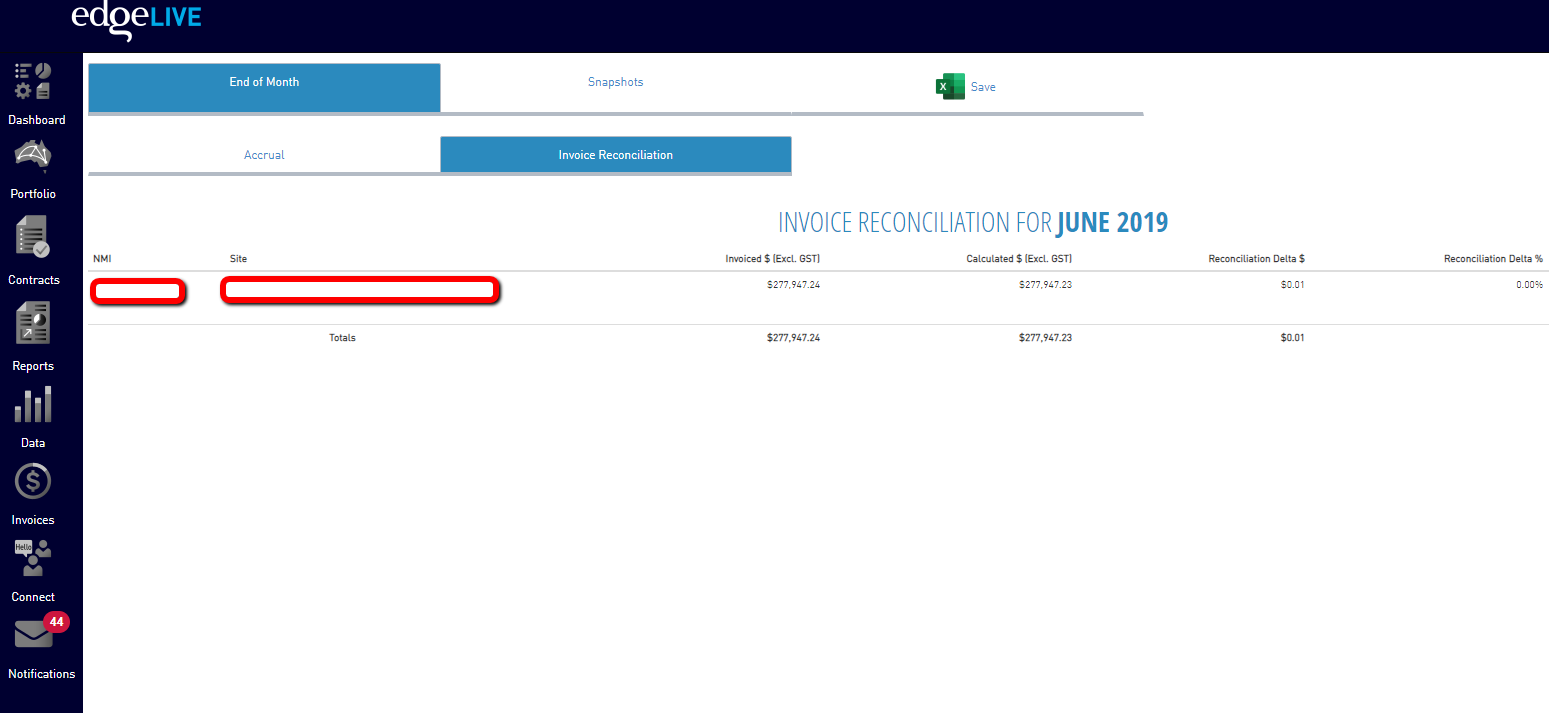
EdgeLIVE now has dedicated dashboards for Accruals and Invoice Reconciliation. The new dashboards display a summary of the invoice for each NMI, as well as a line-by-line breakdown of the individual invoice items. The new functionality is easy to follow and can provide users with as little or as much detail as is required.

Snapshot Dashboard

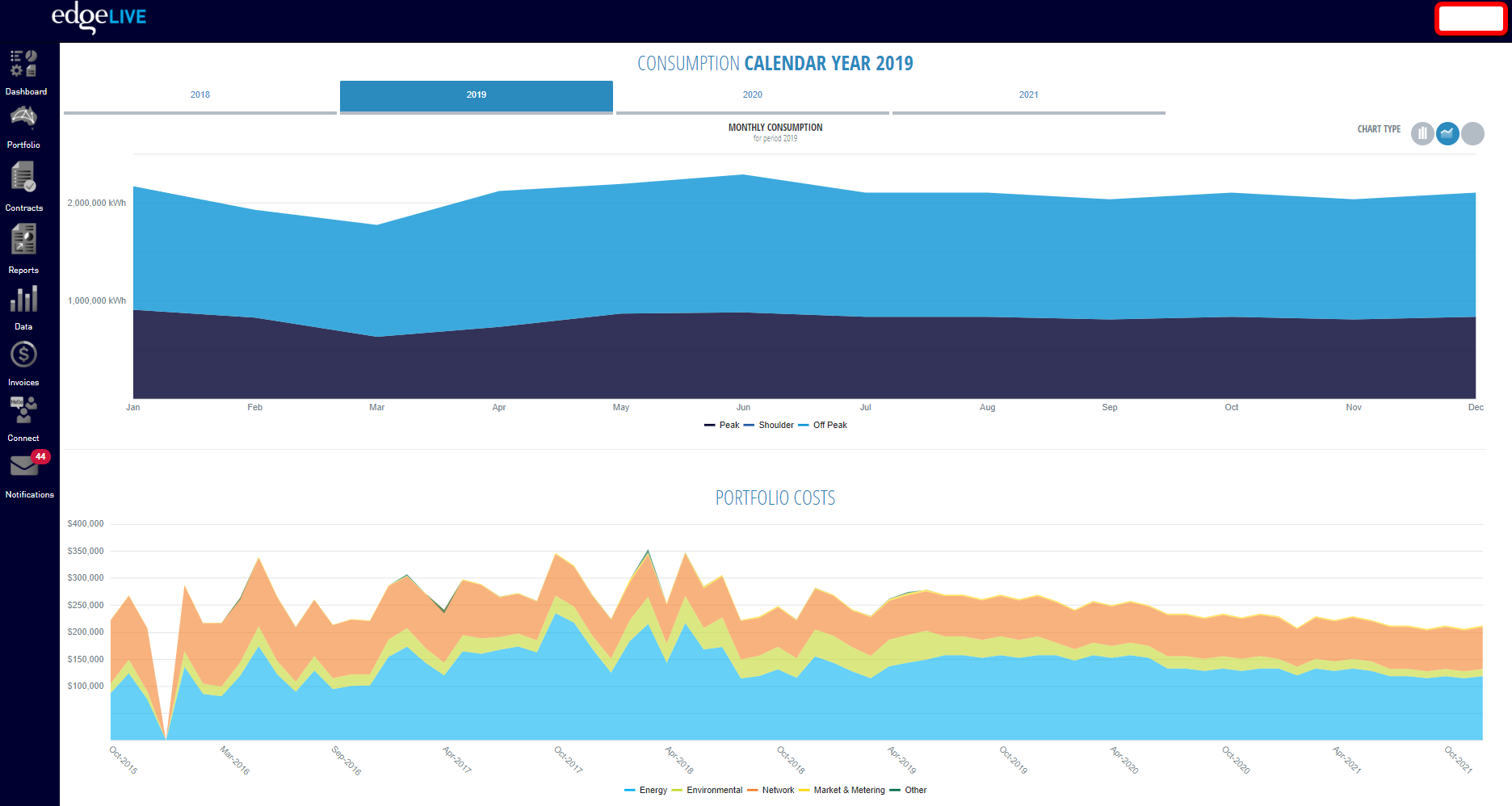
EdgeLIVE also contains a snapshot dashboard to provide a visual representation of both actual and forecast energy costs for our customers’ whole energy portfolio. The snapshot dashboard contains a range of graphics and tables to show trends relating to costs and consumption on a portfolio, asset or NMI level.

Export functionality

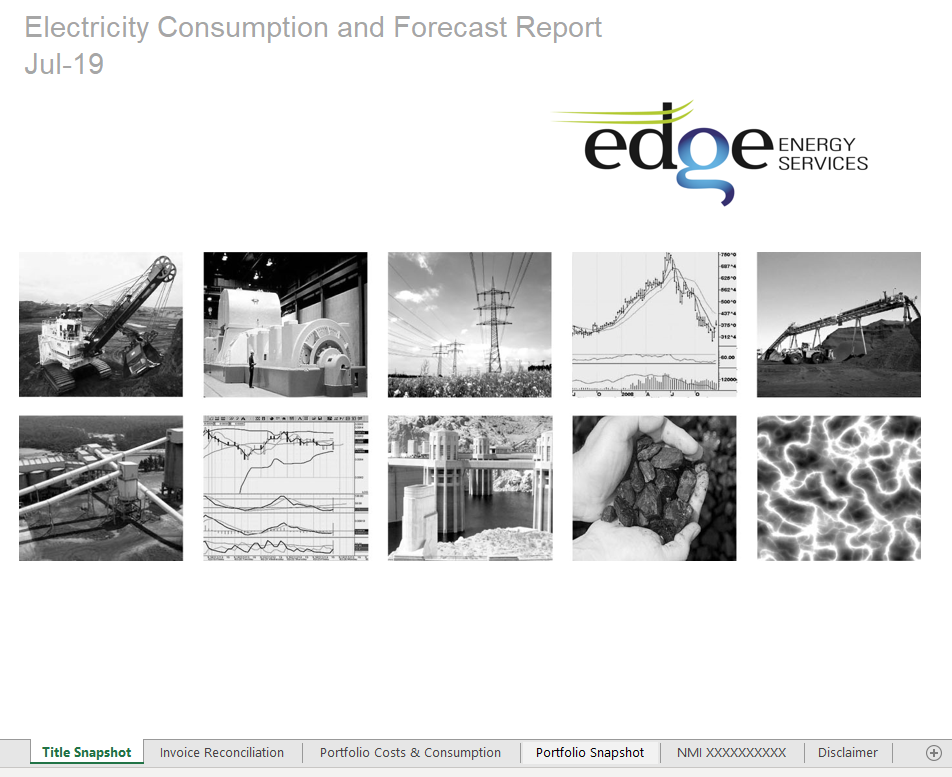
In addition to the online dashboards, EdgeLIVE also allows the export of accrual, invoice reconciliation and snapshot data to a ready-designed report format in Excel. As with the dashboards, this report shows actual and forecast costs and consumption on a portfolio or NMI level.

The exported report is delivered directly to your email to save for future reference and is ideal for use in your budget processes or as inserts into any business presentation or documentation.

Upcoming changes

In addition to the above, our technology team continue to work on further developments to be released. Over the coming months we will introduce a finance dashboard which will track spend against retailer purchase orders and display live tracking of savings achieved, such as early payment discounts.

If you would like to discuss our EdgeLIVE platform, please contact Edge on 07 3905 9220.

Supporting Mater Little Miracles

Finding a charity to donate to can be a tough exercise considering the fantastic work that hundreds of charities do on a daily basis. Having worked with many charities in the past as an organisation, Edge’s National Sales Manager, Mike Ricketts, has been donating to Mater Little Miracles for 3 years now.

What do Mater Little Miracles do?

Every baby born at Mater is a Mater little miracle. That’s one in seven Queenslanders and more than 10,000 new babies every year who can proudly say, “I’m a Mater baby.”

But sadly, not all babies are born healthy. Some are born premature, are seriously ill, or are simply too small to go straight home with their parents.

Mater is dedicated to providing the best possible start to life for the seriously ill and premature babies cared for at Mater by raising vital funds through Mater Little Miracles.

More than 2,000 babies each year will have to spend time in our Neonatal Critical Care Unit (NCCU) where specialist staff treat and care for up to 79 seriously ill and premature babies every night.

Some babies are born as young as 24 weeks and weigh as little as 400 grams, some have come from as far as Cairns and Townsville for the specialist neonatal care for which Mater is renowned.

Thanks to donations like Mike’s, the Mater Foundation has provided over $51 million of funding to health, education and research.

If this is your first time, we encourage you to donate and if you are a regular, we thank you. To donate or to learn more about Mater Little Miracles, please follow the link – https://www.materlittlemiracles.org.au/

STAFF PROFILE – Mike Ricketts

What is the best piece of advice you have ever received?

The best piece of advice I’ve ever received would have to be ‘Don’t worry about the things you can’t control but focus on the things you can.’

Name a place you have never been to and would like to visit. Why?

I have always wanted to visit the Amazon Rainforest. The sheer scale of it is mind blowing.

Who or what inspires you?

Individuals that have been classed as ‘disadvantaged’ by society but live a life just as full as any other. Seeing ‘less fortunate’ people enjoy what they have is extremely inspiring.

What is one of the biggest challenges facing energy customers today?

I feel the biggest challenge customers/consumers face today is the everchanging nature of the market and industry. With constant regulation changes, price spikes and conflicting opinions, our role in the industry becomes more and more prominent year on year. It keeps it interesting for people like me, motivating me each day to assist businesses understand and stay ahead.

What does a typical day look like for you at Edge?

A typical day for me is full of energy and fast paced. I am constantly looking for new ways to improve and grow the business whilst learning all I can about this complex industry. There is always something to do.

Enhancements to RERT

The Reliability and Emergency Reserve Trader (RERT) is an existing intervention mechanism that allows the Australian Energy Market Operator (AEMO) to contract for additional reserves such as generation or demand response that is not otherwise available in the market. AEMO uses RERT as a safety net at times when a supply shortfall is forecast or where practicable for power system security.

RERT is classified as an emergency reserve or strategic reserve as it may only be used as a last resort to avoid unnecessary load shedding. This is typically required when the market is under pressure from extreme weather or during unexpected generation failure.

RERT can be additional generation or load curtailment that must be able to respond on request from AEMO. It cannot be available to the market including through any agreement or arrangement including demand side management agreement. The amount procured is to ensure AEMO meets the reliability standard in all regions.

Demand Side Participation or demand side response (DSR) comprises the largest component of RERT. DSR could be when factories or manufacturing processes adjust their production in order to reduce electrical load. Once enabled DSR is relatively simple to manage however the contract negotiations, setup and determination of volume and times are complex. Payments are made up of an availability fee and a dispatch fee which as it is linked to lost production is generally high.

Participants will normally require several hours or days notification and may also have minimum and maximum constraints on volume and time periods.

Enhancements to RERT

The AEMC has released new rules to reinforce the emergency reserve mechanism to protect reliability and encourage the long-term capacity of RERT services at the lowest cost and reduce the occurrences where AEMO is required to use higher cost safety net options.

The market is evolving so the emergency reserve framework needs to evolve to allow AEMO to be more flexible to meet the operational needs of a market with a Large number of smaller generators compared to the current grid made up of a small number of large generators.

New RERT Rules

Improve incentives for customers to reduce demand and minimise the need for emergency reserves

The rule is to incentivise more demand response. Retailers and demand response providers can reduce energy during generally high demand times by incentivising end users to reduce energy when most required.

Increased transparency

There is a recognition of the impact of the RERT on the market and consumers. AEMO will be required to provide regular update on the procurement, usage and cost associated with RERT. AEMO will introduce new reporting requirements to clearly explain the reason for RERT procurement.

Clarify the trigger

If AEMO forecast that there is not enough generation available to supply 99.99% reliability standard the RERT can be triggered. The procurement volume will be the amount AEMO considers is reasonable to fill the gap to meet the reliability standard.

Lead time to buy reserves increased to 12 months

The planned retailer reliability obligation RRO has two triggers. The three-year trigger requires retailers to bring dispatchable firm capacity to market if there is a supply gap three years out. If retailers have not filled the gap 12 months out then AEMO can use the RERT.

Encourage a lower-cost competitive market response

Through the rule changes, AEMO are seeking a lower-cost reliability response from market participants and through current market mechanisms (ie. generator recall) to avoid levers such as load shedding and use of emergency reserves.

Guidance to AEMO on costs

Providing AEMO with guidance as to costs when entering into emergency reserve contracts, along with aligning costs of the emergency reserve contracts with the customers who have caused the requirement for emergency reserve procurement, increasing transparency of costs, and assisting market participants and customers in planning for such costs.

AEMO with flexibility

AEMO has flexibility and discretion as to how the reliability standard is incorporated in its day-to-day operations, particularly through its modelling and forecasting of power system risks.

Benefits

As RERT procurement will be linked to the reliability standard there will be greater transparency as to when and how reserves will be used, this will assist in the planning for RERT costs by market participants and consumers.

Allowing AEMO more flexibility in the range of services it can procure, allows it to better incorporate these services into the day to day operation of the NEM.

Increasing the lead time for procurement of RERT from 9 months to 12 months will allow more RERT providers to participant and likely will result in lower costs to end users.

Changes also allow the cost associated with RERT to be aligned with customers who caused the need for RERT.

Implementation

The enhancements to RERT will be implemented over two stages, reporting commencing 31 October 2019 and the remaining components commencing 26 March 2020.

The timeframe is to allow AEMO to finalise internal processes and the RERT guidelines to be updated.

If you would like to know more about the enhancements to RERT and how your business may be affected, please call Edge on 07 3905 9220.