Chubb report

Chubb report carbon offset

The long-awaited Chubb report was published on Monday 9th January 2023. Its purpose to “ensure Australian Carbon Credit Units (ACCUs) and the carbon crediting framework maintain a strong and credible reputation supported by participants, purchasers and the broader community.1

The government has agreed (in principle) to enact all the proposed recommendations.

But let’s start at the beginning. The Chubb review came about following claims that the scheme was not robust, being managed badly and not fit for standards, especially on the international stage.

Following the King report in 2020 this view was exacerbated by the Clean Energy Regulator (CER) taking on an even larger role in this opaque market, holding the keys to the design of ACCU methodologies, registration and regulation of those projects, a data source for the “independent” ERAC (the Emissions Reduction Assurance Committee – the independent committee overseeing the ACCU market) and buying ACCUs on behalf of the Australian Government. Some may say it was a keys to the castle type deal.

Therefore, transparency and independence were unsurprisingly the key focus for the Chubb review. Both from the regulatory and data access standpoints, obviously maintaining privacy where required. With upcoming changes in the Safeguard Mechanism expected to come into force in the new financial year and increasing interest in ACCUs from the Hydrogen industry (to ensure certification meets international standards such as CertifHy) the robustness of the scheme must be unimpeachable.

I think the most interesting part of the review is the u-turn from the previous Morrison government’s stance, which mandated in 2021 that their own Climate Active standard would have required members to increase their “carbon neutrality” through a minimum of 20% or 30% ACCUs dependant on size. This reversal, to no such mandate, is showing the business community at least that an international certification is enough for this government. Not the strong climate stance that is being pitched from the floors of Canberra.

As with many of these papers I am finding little accountability and more future safeguarding. Especially around human-induced regen (noting that ends this year), carbon capture and storage and landfill waste gas, with no individual projects reviewed, the current standard of certification cannot be confirmed, yet it is likely to be significantly tightened if the advised transparency is enforced.

Overall, I can’t help feeling this was not more than a necessary boondoggle, yes some interest groups have had some wins, but it was necessary to achieve its end – it is going to undo a significant number of the controversial King review and Morrison Government changes.

Reversal however will come at a price, there will likely be a significant amount of funding put in place to reduce the both “real and perceived,” burden on both the CER and especially the Emissions Reduction Assurance Committee (ERAC). The latter of whom will be dis-banded and renamed the Carbon Abatement Integrity Committee (CAIC), moved out from the CER with full data access restored and with a remit which, if enacted within 6 months, could see them as an Independent Statutory Authority, a level the ERAC currently hold but are handcuffed from enacting upon.

Personally, I think any changes which bring transparency to this market, its accreditations and oversight can only be positive. There is still the government tender for an ACCU exchange to be developed which would further assist this transparency, but I also fear it has stopped short of really making the Carbon Market in Australia un-penetrable.

With Climate Active still supporting accreditations from Certified Emissions Reductions (CERs), Verified Carbon Units (VCUs) amongst others and an increasing number of lesser regulated Carbon Neutral certificated (iRECs etc) being used for Carbon Neutral Claims, I think this review could have used its opportunity to ensure the Australian Carbon Neutrality Certification would be seen as a world leader. Instead, I fear it is trying not to shake an already leaking boat, with pressure for ACCUs likely to increase with Safeguard changes and the HIR methodology ending in 2023, as well as the new “REGO” scheme being touted as “voluntary surrender only” with no regard for the impact to the LGCs market. Another knee jerk could have put too much price pressure on a market which is not only opaque but likely to come under significant demand, and that is before the increased scrutiny once data is widely available.

No, the Chubb review has done its job, it has unwound a lot of the misgivings people had. It should increase transparency, a feat which has been loudly called for in this market since its inception 11 years ago and not ruffled too many feathers in the process. I guess I just hoped for more.

References: 1: https://www.dcceew.gov.au/climate-change/emissions-reduction/independent-review-accus

Kate Turner is Edge2020’s senior manager markets, analytics and sustainability. Through a passion that renewable energy solutions are key to any climate change solution, Kate supports our clients to manage their portfolios and any associated risk within traditional markets as well as complex renewable energy portfolios. Kate is hands on in procurement development and implementation for our clients and leads our market regulatory and advisory sustainability services. If your business is interested in wholesale or retail renewable PPAs we’d love to help you. Contact us on: 1800 334 336 or email: info@edge2020.com.au

Does another new environmental scheme create more uncertainty?

Australia's renewable energy schemes

In December the Department of Climate Change, Energy, the Environment and Water released two papers. One on Renewable Electricity certification and one on the Guarantee of Origin Scheme.

These are mainly aimed at the hydrogen industry but the first could have a significant impact on the electricity sector if the proposals are implemented as per the position paper.

The Renewable Electricity Certification paper asks for feedback on the need for a new mechanism for electricity to be certified, currently to be used only for voluntary surrender purposes. It proposes it will act alongside LGC creation (Large-scale generation certificates) with the developer able to decide if they produce an LGC or a REGO (Renewable Energy Guarantee of Origin certificate) on any given period, in any given day.

The REGO can be used for all uses, bar RET liability i.e., voluntary surrender.

The main difference of the REGO to the LGC elements being proposed in the paper are:

  • It proposes to allow the use of below-baseline generation to create a REGO.
  • It will also allow STCs systems to create a REGO once the maximum deeming periods from date of installation has been met. If the minimum threshold isn’t met they can aggregate multiple small scale systems to create a certificate.
  • Further it suggests almost a double counting whereby a battery could purchase REGOs to “store” green electricity then re-sell as green electricity with a new REGO.
  • For exporting renewable energy i.e. Sun Cable whereby the REGO can be created even though the electricity is exported overseas, this is not allowed under the RET scheme for LGCs. How we can claim that against a domestic usage is yet to be seen!
  • There is a proposal any vintage can be surrendered at any time for this year’s claim
  • It is also worth noting a REGO would require a time stamp under the proposals – meaning hourly matching could be undertaken. However, a note for is you are in an aggregated system for the REGO the last hour to make the 1MWh REGO would be the one counted.

It is proposed this will allow claims post the sunsetting of the RET in 2030 but does not go as far as to state it will replace the RET – however this must be implied that it is the intention of the scheme.

If this is to go ahead there are a few concerns:

  • Will it crash the price of the LGCs?
    • Could the market be flooded with “equal value” REGO certificates and bar RET liability the LGC market move?
  • Alternatively – What happens to the LGC market if everyone signs up to REGOs – would it mean LGCs could potentially go up in price as people are only creating REGOs and the LGC RET liability can’t be met
  • Will it increase volatility with an arbitrage being available between the two schemes?
  • Does this really level the playing field for Hydrogen in the way they think it will? I am not sure we meet all criteria in the market leading hydrogen certification markets with this proposal
Consultations close 3rd Feb but this is one to watch. It may be being pushed through a side door but it could blow open the LGC market as we near the end of the RET scheme. Have your say here: https://consult.dcceew.gov.au/aus-guarantee-of-origin-scheme-consultation   


Coal and gas moves to renewables and storage

Renewable generators with battery storage

With Enel X announcing the installation of battery storage systems in shopping centres in Melbourne and on the NSW central coast, this year may see a shift in the energy market as we transition from coal and gas to renewables and storage.

Recently AEMO’s CEO Daniel Westerman said, ‘even after factoring the cost of new transmission lines, wind and solar remain by far the cheapest forms of new power generation’.

Key federal policies have underpinned the need to progress an increase in renewable energy. Growth in renewable energy is dependent on the growth of storage to be fully utilised and the need for greater transmission infrastructure is required to link the projects to the end users.

The announcement of the Net-zero emissions target of 43% of 2005 levels by 2030 have pushed other mechanisms to also ramp up across the country. The key federal mechanism is the Safeguard Mechanism, which targets the emissions reduction for Australia’s largest emitting facilities. In line with the Safeguard mechanism the 82% renewables energy target in the National Electricity Market (NEM) by 2030 is also incentivising renewable generation. As both these drivers will require more renewable energy to be rolled out to offset the thermal generation, more storage will be required to compensate for the intermittency of renewable generation and an increase in transmission lines will be required to connect the renewable energy projects with storage and end users.

AEMO has for many years been looking at a fundamental shift in generation, transmission and energy usage. AEMO is now focusing on firming, Electric vehicles and the regulatory framework to enable these changes to occur.

In recent years we have regularly seen that the NEM has the potential to operate with very high levels of renewables, but the limiting factor still remains that thermal generation provides reliability and system security when the wind is not blowing or the sun is not shining. At the end of December, South Australia produced 104% of its demand with renewable energy and exported the extra electricity to neighbouring regions.

With most states striving for high renewable energy targets, Victoria is hoping to reach 95% renewables by 2035 and Queensland has increased its target to 80% renewables by 2035.

With the recent volatility in the overseas energy markets, in which Australia is a pivotal player in due to the large quantities of coal and gas we export, there is now a greater incentive to shift away from thermal generation due to the volatility and high prices.

AEMO reports show there is currently 21GW of new projects undergoing connection assessment and they expect 5GW of new capacity to be added during FY2023, in addition to the 4GW currently operating.

To assist this influx in renewable generation ARENA granted $176m in December 2022 to fast track 8 new battery projects to bring in 2.0GW/4.2GWh of storage. The plan is to triple the battery storage across the NEM by 2025.

Over the next year we will also see more transmission lines connecting the nation as more renewable energy zones are connected to the load centres under the Rewiring the Nation policy.

The first transmission projects to receive Rewiring the Nation funding were announced following the October 2022 Federal budget. Recently funded projects include the VNI NSW-Victoria interconnect, Marinus Link and various NSW transmission projects connecting the renewable energy zones. This funding will assist in building the transmission lines over the next 10 years.

If your business is interested in wholesale or retail renewable PPAs we’d love to help you. Contact us on: 1800 334 336 or email: info@edge2020.com.au

Coal price caps result in high compensation but lower forward prices

Last week reports emerged that one coal fired power station could receive up to $450M in federal compensation as a result of the price cap on coal. Under the new legislation, coal fired generators are compensated for the cost of coal they have locked in at prices above the $125/t cap.

The coal price cap is likely to be higher than the coal currently locked in by many coal fired power stations, however some power stations are exposed to higher priced coal. Under the coal price cap mechanism, generators must bid into the market at a price inline with coal procured below the coal price cap. Generators that are exposed to coal prices above the coal price cap will not be able to dispatch their unit unless generating uneconomically. The compensation is designed to level the playing field allowing the units with fuel costs above the coal cap to continue to supply power and assist in system security.

Based on the current price of coal, compensation for Queensland’s Gladstone power station could reach $450m. The compensation will be split between the Queensland and federal governments on a 50/50 basis while the $125/t coal price cap is in place. The total compensation amount will vary depending on the amount of coal procured at prices above $125/t.

Many may argue that generators with high costs should be forced up the bid stack and not be compensated for high fuel costs. While stations like Gladstone may not have the benefit of low coal prices the station is currently crucial to system security in Queensland. Gladstone is not the only coal fired power station to receive compensation. In NSW, Origin’s Eraring power station will also receive compensation.

The coal cap legislation forbids coal producers from selling coal to domestic generators above the price cap and electricity generators must dispatch into the NEM at costs that reflects the cost of coal procured below the coal cap. The changes in bidding have resulted in the forward market electricity prices dramatically falling with the likelihood of future contract prices to level off in line with new long run marginal costs.

Below is a summary by state of recent activity:

QLD
  • QLD prices ranged between -$78.70/MWh and $270.00/MWh for the 2 weeks ending 31st December 2022, averaging $67.59/MWh.
  • QLD Q422 prices ranged between -$122.18/MWh and $15,500.00/MWh , averaging $120.24/MWh.
  • Solar output fluctuated across the period with output peaking close to previous weeks at 2,106MW, during the negative spot period the output was economically curtailed. Cloud cover also reduced output.
  • Apart from Christmas eve, wind generation displayed a consistent negative correlation with solar. Output peaked at 685MW leading up to Christmas then reduced to a normal maximum of 450MW for the remainder of the year.
  • Gas fired generation including Swanbank E, Townsville, Roma and Condamine covered the evening peaks with the exception of Yarwun that operated 24/7.
  • Wivenhoe hydro generation reflected the gas generators by covering the evening peaks and evening while Kareeya continued to generate around the clock.
  • Coal fired availability remained high with Gladstone taking a unit off over the Christmas / New Years break, Kogan creek returned to service on 20th December and remains online. Millmerran 1 came offline on the 30th and remains offline. All other operating as expected.
NSW
  • NSW prices ranged between -$69.20MWh and $223.54/MWh for the 2 weeks ending 31st December 2022, averaging $73.60/MWh.
  • NSW Q422 prices ranged between -$120.00/MWh and $15,500.00/MWh, averaging $115.66/MWh.
  • Most price spikes are now being capped below $149/MWh lower than the previous $300/MWh cap, this is likely as a result of the cap on gas.
  • Solar output fluctuated across the period with output peaking close to previous weeks at 2,367MW, during the negative spot period the output was economically curtailed. Cloud cover also reduced output.
  • Wind output dropped as we approached Christmas then increased to peak at 1,436MW at the end of the year.
  • Tallawarra was the only gas turbine to generate over the Christmas break due to relatively low prices.
  • Coal fired availability remained high despite various movement in units, Bayswater returned to service on the 20th but Eraring and Vales Point both took units offline over Christmas. Eraring returned to service on the 2nd January but the Vales point unit remains offline.
SA
  • SA prices ranged between -$605.41/MWh and $4,027.21/MWh for the for the 2 weeks ending 31st December 2022, averaging $41.19/MWh.
  • SA Q422 prices ranged between -$1,000.00/MWh and $15,500.00/MWh , averaging $63.67/MWh.
  • Solar generation peaked at 435MW on the last day of the year but maximums averaged 350MW. Negative spot prices caused units to be constrained.
  • Wind generation was sporadic reaching a high of 1,915MW but also dropped to less than 10MW occasionally. The SA market spiked on two occasions, both times the output from wind generation dropped significantly.
  • Thermal generators continue to operate over the evening peak when spot prices are generally higher, however they are operating during other parts of the day when spot prices are high. Torrens Island is operating all hours of the day, but Quarantine, Barkers inlet, Dry creek and Pelican Point have reduce run times as they focus on higher price periods.
VIC
  • VIC prices ranged between -$141.51/MWh and $228.44/MWh for the 2 weeks ending 31st December 2022, averaging $36.17/MWh.
  • VIC Q422 prices ranged between -$996.18/MWh and $584.31/MWh , averaging $62.86/MWh.
  • Solar generation was heavily constrained due to negative prices, solar output peaked at 797MW.
  • Wind generation was sporadic reaching a high of 2,871MW but also dropped to less than 5MW occasionally.
  • Hydro generation continues with its strategy of only operating Murray over the evening peaks, with Dartmouth, Eildon and Bogong adding additional generation when required. Hydro generation continues to increase during the high price periods. Hydro generation across Victoria and NSW has been used to keep a cap on spot prices, however the market is now capping around $140/MWh rather than the traditional $300/MWh cap price.
  • Yallourn continues to have various issues over the Christmas break with unit tripping followed by a fail return to service of unit 1, by the end of the year Yallourn was operating with 3 units. The Loy Yang A & B station operated consistently across the last 2 weeks of the year, continuing with the strategy of reducing generation during low price periods.

At Edge2020 we help our customers navigate the ever-changing energy landscape and to ensure the proactive and accurate delivery of advisory, account, and portfolio management services and associated outcomes. If you could benefit from an expert eye on your energy portfolio, we’d love to meet you. Contact us on: 1800 334 336 or email: info@edge2020.com.au

Energy users wait for lower price after intervention bill

Following the passing of the energy reform bill in Canberra last Thursday, end users are waiting to see when the price of gas and electricity starts to match the caps imposed in the wholesale market.

Prior to the passing of the intervention bill, end users were looking at gas deals above $30/GJ. Now a cap of $12/GJ has been imposed, what will be the offer price to gas consumers? AGL have been quoted,

“as soon as the legislation is passed, they will try to get some better offers”

The legalisation covers uncontracted wholesale gas and capping this portion of the market at $12/GJ may not see the benefits flow through to end users.

Large end users of gas have the option to procure gas from the spot market, this segment of the market is not covered by the $12/GJ cap so prices in the gas spot market are likely to be higher than $12/GJ. So, with coal prices peaking again above $300/t is there the potential for gas to now be the transitional fuel to renewables?

The war in Ukraine has influenced the transition to renewables and potentially speed the process up worldwide. European countries are now less likely to take significant volumes of gas from Russia, so they will be looking at alternative fuel sources. As a result of the gas supply issues out of Russia, some European countries are reviving their coal fired generation fleet while they transition to renewables.

While international gas prices remain high, Australian gas producers have been very vocal in leaving the domestic gas market alone and let it work as intended. They argue the gas market will fix itself, higher prices will signal the investment in new supply, resulting in lower long term energy prices.

The gas market is currently proving to be very profitable for producers at the expense of end users. A recent report from the regulators exposed that the majority of offers for 2023 gas were over $30/GJ and a report out of AEMO shows the cost of production is $9.50/GJ or below. With a potential continuation of the $20/GJ profit for gas producers they will be pushing to make gas the transitional fuel and push out the coal industry.oc

While the intervention bill is designed to be in place for 12 months, the ACCC has flagged an extension to the reasonable pricing framework saying they,

“would be expected to be required until domestic gas prices are reflective of the underlying costs of production and that there is sufficient supply at these prices”.

At Edge2020 we will continue to monitor both the gas and electricity markets to understand the impacts these market caps will have on the prices offered to end users.

Edge2020 have an eye on the energy market, enabling us to support price  benefits as well as customer supply and demand agreements. Our clients rely on our experts to ensure they are informed, equipped, and ideally positioned to make the right decisions at the right time. If you could benefit from an expert eye on your energy portfolio, we’d love to meet you. Contact us on: 1800 334 336 or email: info@edge2020.com.au

Federal and State Government agree to power bill

On Friday National cabinet met and agreed on the states introducing a cap on wholesale gas and coal. The temporary cap will be set at $12/GJ for gas and $125/t on coal. The caps will not enforce on export contracts therefore not limiting the opportunities on high international prices.

During the meeting it was agreed that the states would sort out the coal cap and the federal government would change laws to legislate the $12/GJ cap on domestic gas. As the caps are focused on the domestic market, they will only have a small impact on the profitability of producers. It is anticipated that only 4% of gas and 10% of coal will be affected by the cap, the remaining volumes will be exposed to international markets.

As the states have been tasked with implementing the cap it is likely they will go down different routes in achieving the same outcomes. The simplest state to implement the changes will be Queensland as the government still owns and control 80% of the coal fired generation fleet. Queensland will likely use its directive powers and instruct its government owned corporations (GOCs) to dispatch the coal assets below specific prices. NSW will likely use changes in law to cap the price for the state.

In line with the price caps, national cabinet also discussed an assistance package to lower the impact on families and business as a result of high inflation and high commodity prices.

The cap mechanism will be used for uncontracted gas and coal, this may have limited impacts on generators as the majority of coal and gas has already been produced under longer term contracts with strike price below the proposed caps.

At this stage it is unlikely that the mechanism will be in place until February despite federal politicians being recalled to Canberra on Thursday to discuss the issue. While the bill will get the support of the House of representatives it is expected the Greens will put pressure on the Government in the Senate to limit any compensation for the coal producers.

When the futures market opened on Monday morning it was evident the traders expect the caps to flow into the market. Both QLD and NSW futures dropped by $20/MWh for later dated quarters and over $30/MWh for Q123.

Edge2020 have an eye on the energy market, enabling us to support customer supply and demand agreements. Our clients rely on our experts to ensure they are informed, equipped, and ideally positioned to make the right decisions at the right time. If you could benefit from an expert eye on your energy portfolio, we’d love to meet you. Contact us on: 1800 334 336 or email: info@edge2020.com.au

Slow growth in renewable energy

The Clean Energy Council (CEC) recently released to its members their quarterly renewable projects report, which showed only one renewable project, Stubbo solar farm, reached financial close in Q3-2022. The 400MW Stubbo solar farm situated in NSW demonstrates the slowing of the renewable industry. Renewable project growth has slowed by almost 30% compared to Q2 -2022 and over 60% slower than Q3 -2021.

While politicians are talking up the prospects of a renewable energy driven industry to reduce the impact of climate change, the reality reaching the 44GW target outlined by the federal government may be hard to achieve at the current rate of growth. To meet the 44GW target by 2030, a significant number of new wind, solar and storage projects need to come online. If these projects do not happen, the retiring coal generators cannot be replaced and may be forced to remain online.

The CEC says investment in renewable is at an all-time low. Quarterly investment has dropped almost 60% to $418M.

As well as the federal announcements, QLD and VIC have also announced ambitious renewable targets linked to the transition from coal fired generation.

Recently the Federal Minster for Climate Change and Energy estimated Australia must install 22,000 500-watt solar panels every day for eight years, along with 40 seven-megawatt wind turbines every month, backed by at least 10,000 kilometres of additional transmission lines to meet its commitment to reduce emissions by 43 per cent by 2030. This is what is required for us to reach a target of 82% renewables by 2030.

While only one project reached financial close last quarter, three projects started construction during Q3-2022 with an increase of installed capacity of 902MW. As well as another two projects that completed commissioning during Q3-2022.

The Stubbo solar farm project also included a storage device, being the only storage device to reach financial close.

Currently, there are 247 financially committed renewable projects in Australia, with 221 under construction and 169 undergoing commissioning.

The CEC notes that the desire to build new solar, wind, pumped hydro, and transmission lines are meeting opposition from local communities. For example, projects like the Chalumbin wind farm, situated next to World Heritage-listed rainforests in North Queensland are reducing the number of wind turbines they are installing by half due to the concerns from the local community. Another example being part of the Queensland government’s renewable plan which included the construction of the largest pump storage hydro station near Mackay. Mackay locals later found out one of their towns has the potential to be flooded as part of the mega project.

With ambitious renewable targets being spruced by politicians and businesses actively seeking renewable energy to aid in the decarbonisation of their operations, the question of where and when these projects will be delivered needs to be asked. The majority of people support the transition to renewables but obviously not in their backyard.


The South Australian island and running on renewables

On November 12th a series of storms passed through South Australia that had the potential to black out the whole state, as had previously happened in 2016. Whilst parts of South Australia did lose power, it was far less dramatic than the last weather event due to a significant amount of work that has been undertaken by AEMO to build a more secure grid since the 2016 blackouts.

In 2017 AEMO released a review of the events that had blacked out the state; the main cause was of course the extreme weather that had knocked over transmission lines as well as some wind farms not meeting protection standards. Similar to 2016, it was destructive storms that passed through South Australia and damaged the network on the 12th November. At 4:59 PM, the market was notified of a significant power system event due to the tripping of multiple transmission lines. Both elements on the Tailem Bend – Southeast 275kV transmission line had tripped. Some transmission towers were damaged and had fallen over, resulting in the South Australian grid being disconnected from the NEM. On Saturday at 6:03 PM, AEMO notified the market that South Australia had been reconnected to the NEM after the 275kV transmission line at Tailem Bend was returned to service.

During events like this AEMO invokes its power to manage system security; however, this time, it went a step further and constrained off-rooftop PV to maintain a secure level of Distributed PV (DPV) generation. AEMO switched off as many rooftop PV installations as possible during the middle of the day, a rare occurrence known as “islanding” of the state grid to maintain stability, designed to keep the DPV below the secure threshold. PV generation is not as easily controlled as other sources. At times South Australia can meet all domestic demand for power via rooftop solar and sends surplus to Victoria but this cannot be managed in an islanded state, therefore requiring the curtailment of the rooftop PV allowing AEMO to manage scheduled and semi-scheduled generation assets to maintain system security.

Smart metering is required to enable the shutting down of rooftop PV systems, however not all South Australian PV systems can be controlled remotely as they have older inverters. This resulted in only 50% of systems being curtailed. Over time as more rooftop PV systems are installed using smart inverters, there will be more control of their output. Currently, AEMO can control 100MW of PV generation, but during the recent event, it also used voltage control to trip off a further 300MW of rooftop PV out of approximately 1,000MW of installed capacity.

The South Australian network has now been re-synchronised to the NEM, and electricity is flowing between South Australia and the other states of the NEM as before. While South Australia was isolated from the NEM for a week, South Australia was powered by wind and solar for up to two-thirds of its electricity demand, with gas providing the difference. System stability is a delicate balance between the supply of electricity, the types of generators providing the electricity and the electricity demand from end users. This time, part of the solution was to encourage end users to consume more electricity, enabling a higher generation level. Before the curtailment, South Australia was supplied by over two-thirds of its demand via renewable generation.

While high levels of renewable generation are good for keeping electricity costs down, the savings can be eroded by high-frequency control costs and the need for a more expensive gas-fired generation to fill the gap when the sun is not shining, and the wind is not blowing.

Edge2020 have an eye on the energy market, enabling us to support customer supply and demand agreements. Our clients rely on our experts to ensure they are informed, equipped, and ideally positioned to make the right decisions at the right time. If you could benefit from an expert eye on your energy portfolio, we’d love to meet you. Contact us on: 1800 334 336 or email: info@edge2020.com.au

COP27

In comparison to the COP26 (Conference of the Parties 26) which occurred with great media attention and pageantry, partly due to the delay due to Covid-19 and partly due to the significance of the promises being made by countries. COP27 kicked off yesterday, 6th November, the 12-day event has received little to none of the media fanfare that was seen in the conference last year.

Our staunchly anti-target ex-Prime-Minister Scott Morrison even attended COP26 (sponsored by Santos!) but to show the stark comparison, our new Prime-Minister Anthony Albanese, who is a big supporter of Climate Targets and moving towards renewables, has opted not to attend the COP27 in Egypt, instead sending Chris Bowen and Jenny McAllister (our Minister and Assistant Minister for Energy) in his place. As we were not announcing any new targets and therefore the importance to attend wasn’t as strong.

Yet we aren’t the only ones shying away, Joe Biden is going to forego his annual nap at the COP conference and is instead sending four Cabinet Officials – sighting the mid-term election as reasoning (as if we don’t all expect a massive flop in those and the GOP to take back the house!). Rishi Sunak, the newest UK Prime-Minister, was not going to attend, yet after significant pressure did a dramatic U-Turn at the end of last week and will be there in Egypt this week. It is no surprise that Vladimir Putin won’t be in attendance, yet the biggest surprise came from China, with Xi Jinping also pulling out and sending a negotiator to participate, the equivalent of sending a toy poodle as they will block everything and agree to nothing.

Yet this conference should certainly have more clout. It is thirty (30) years since the UN Framework on Climate Change was adopted and the first meeting in Berlin took place, and seven years since the massive commitments made in the Paris Agreement.

But does the lack of attention and attendance show that the support is waning? Maybe not long term, but with many countries in dire economic circumstances, Germany and others in Europe throwing out their climate targets around Coal generation, in favour of keeping the lights on, and prices as low as possible in an ever climbing and squeezed market and massive debt and austerity to come from an overspend during COVID, required to ensure their economies didn’t collapse. Standing up and agreeing to tighter emissions targets and the cost implications of this would not play well at the polls, and although a politician may have great ambition for Climate Change they have more ambition for Political safety and longevity.

Last year, at the COP26, world leaders agreed to “revisit and strengthen” their national climate targets annually, if possible, with what seemed like a consensus to produce significant commitments to target Climate Change. They agreed to look at and strengthen their targets every 12 months (previously five years as per the original Paris Agreement) and this was done to try and hold global warming below 1.5 degrees Celsius.

Yet heading into this COP27 only 21 countries have submitted updated climate commitments for their country, with 172 making no change. Of the 21, only Australia has made significant and credible commitments, yet many (everyone!) would argue this was to catch up to the rest of the world and is nowhere near what would be defined as ground-breaking.

Let’s be clear, regardless of politics, regardless of debt and war without significant change, within a decade we will go above the 1.5 degrees Celsius target and above 2.4 degrees by the end of the century. A recession can be reversed, it is awful and hard, but it can be, a war can be stopped, but once this warming has occurred there is no way back, and it will be those on the edges who suffer first and most. An incremental change is not good enough anymore and playing ostrich to ensure your political survival for four more years will not help future generations and ensure the world is thriving.

Yet with world leaders being beyond non-committal, the UN sending out strong statements but with no action and little education on what this means, we are not changing anywhere near fast enough and at some point the cost of it will be on our front door.

I would urge you to follow the public debates and live streams https://unfccc.int/cop27#events or look at the U.Ns campaign to see what “individual Actions” you can do to help reduce everyone’s carbon footprint here https://www.un.org/en/actnow/

I assure you this is not just a big emitters problem, changes by us all could help, and to be clear I do not mean by gluing yourself to a Van Gogh or Vermeer or covering Ferrari showrooms in orange paint.  Gorilla activism is not the answer, their actions are disruptive and not effective in changing the minds of those outside of their own cause. But, all of us taking our positions to the checkout each week will force a change, in the way only free markets can be affected, and that can only benefit everyone now and in the future. I assure you our politicians will not do it for us and this COP27 is just the latest proof of this, unless it is a silver bullet they will not act, therefore we must.

Market Report – Quarter 3 2022

Overview of National Electricity Market (NEM) Quarter 3 2022

International drivers continue to increase gas and electricity prices across the NEM. The main reason for this increase has been and continues to be the tight supply / demand balance resulting from Gas flow restriction in Europe, associated with the war in Ukraine. The reduced flow of gas in Europe has resulted in a greater demand for Australian gas that in turn has put cost pressures on Australian gas market. Higher priced gas then links into to Australian electricity market, leading to higher spot and futures electricity prices.

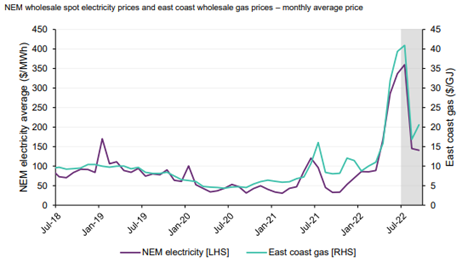
For Q322 electricity spot prices averaged $216/MWh across the (NEM). The Q322 average spot price of electricity was close to matching the all time record of $264/MWh that occurred in Q222. Interestingly, the average price of electricity for Q322 was more than three times higher than the same quarter the previous year. In Q321the average price of electricity was $58/MWh.

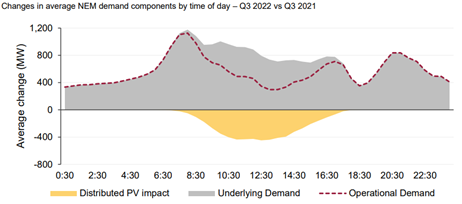
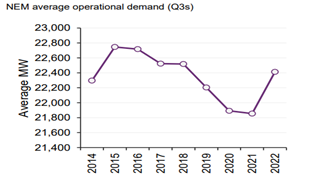
NEM operational demand increased by 2.6% or 559MW to 22,414 MW compared with the same quarter last year. We also saw demand increase for the first time in Q3 since 2015. Households and businesses used more electricity from the grid as a result of their underlying electricity consumption increasing and the output from their rooftop Photovoltaic systems (PV) not generating as much as normal due to cloudy conditions.

High spot prices occurred at the start of Q322 on the back of record high spot prices seen across Q222. The July NEM monthly average of $360/MWh was $23/MWh higher than the June 2022 average of $337/MWh. Later on in the quarter spot prices fell with August Electricity prices averaging $145/MWh across the NEM. Until this year QLD, NSW, VIC and TAS have not recorded a Q3 average electricity price of over $100/MWh. South Australia reached this milestone in Q316 at $119/MWh.

Historically Q3 is not a volatile quarter, but this year it is different, Q322 saw 24% of the dispatch intervals with a price over $300/MWh. This is on the back of the previous quarter, in July prices exceeded $300/MWh 61% of the time, the highest monthly proportion since  the start of NEM. Many intervals saw prices in the $300-$500/MWh range resulting in spot prices moving above the historical price cap threshold of $300/MWh.

Below are the drivers that elevated spot prices and volatility in Q322.

  • A reliance on thermal generation (coal and gas fired) with higher fuel cost due to the increased demand for these resources internationally.
  • Hydro generation setting prices at elevated levels due to limited water supply and bids adjusted to meet revised trading strategies.
  • An increase in demand as consumption increased and rooftop PV generation reduced due to cloudy skies.
  • Price volatility significantly increased the average spot price of electricity with large jumps in spot price due to the distribution of generation offers within the bid stack. The market operator stacks all offers from lowest to highest to build the bid stack. The spot price for a trading interval is the offer price of the marginal unit at the required generation level to meet demand. The bid stack ranges from -$1,000 to $15,500/MWh. During August the spot price reached over $1,000/MWh as generators withdrew generation for technical and economic reasons.
  • With higher average electricity prices we also saw less negative electricity prices across the NEM. In the previous year we experienced negative prices 17% of the time but for Q3 we have only experienced negative prices 9% of the time.

Weather

A La Niña event was declared across the NEM increasing the likelihood of above average winter-spring rainfall across much of northern and eastern Australia, while a negative Indian Ocean Dipole (IOD) event increased the likelihood of rainfall across southern and eastern Australia. Q322 was very wet, with many sites recording their wettest July on record. Wet weather continued across Q3 with September’s rainfall being the fifth highest on record across Australia. Temperatures at the beginning of the quarter were below average in many parts of Victoria and Tasmania and above average minimum temperatures occurred across south-east Australia.

La Niña resulted in wet and cloudy conditions impacting solar generation and the supply of coal to power stations, in additon to the export market resulting in higher prices.

Electricity Demand

As outlined above the NEM demand has changed since the same time last year, the below chart shows this graphically.


The chart below shows how the demand in Q3 has increased in recent years.


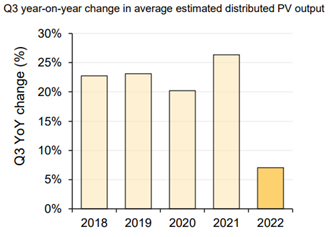
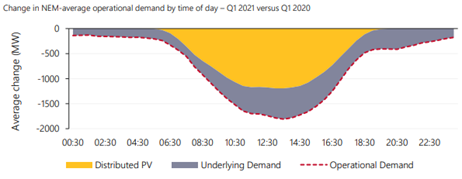
The charts below also show the slow down in the growth on rooftop PV and change in operational demand.


NEM Spot Prices

NEM spot prices have increased significantly and have reached unprecedented levels.

The cost of the underlying fuels for generators has led to these increases. Coal and gas prices are at all time highs due to international demands leading to a high cost of generation. The chart shows the correlation between East coast gas price and the price of electricity. Coal also corelated closely to the cost of generation and a resulting electricity spot price.

Prices have also increased as renewables generation (solar, wind and hydro) is lower due to cloud cover reducing solar, low storage levels reducing hydro generation and hence it bids in at higher prices. There have also been large swings in the output from wind which results in spot market volatility.


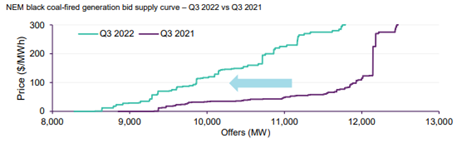
Generation and Offer Prices

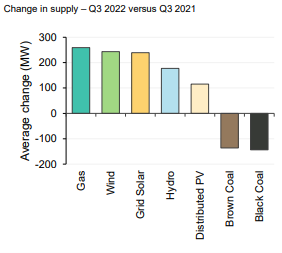
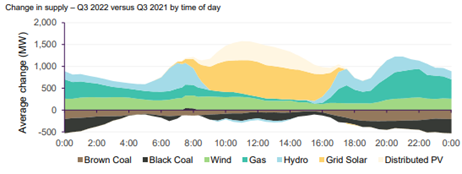
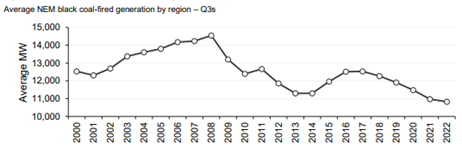
Gas contributed the most to supply in Q322 and as result of the high cost of gas this has influenced the average spot price.The lower volume of generation from coal was a result of bidding behaviour withdrawing thermal capacity and intermittent generation like solar and wind taking a larger market share.

A lower capacity factor for coal generation has resulted in coal fired availability moving higher up the bid stack resulting in coal fired generation needing to dispatch at higher spot prices to meet their long run average costs.


Emissions

NEM emissions intensities declined this quarter slightly to 0.6 tCO2-e/MWh. Total emissions were 0.2% lower than Q321.

Australian Stock Exchange (ASX)

The futures market was influenced by a higher spot market, gas prices and the delays experienced with large scale renewables, a slowing in the rooftop PV market and climate conditions likely to reduce the output from solar generation.

The future price of electricity traded on the ASX for Calendar 2023 (Cal 23) continued to increase in price across the quarter in the four NEM mainland regions. Cal 23 New South Wales futures finished the quarter at $232/MWh, with Queensland at $224/MWh, South Australia at $193/MWh and Victoria at $157/MWh.


Credits: All charts in this report are sourced from AEMO


Edge 2020 offer market leading services for business energy users who require a resource they can trust. We help you navigate the ever-changing energy landscape and ensure the proactive and accurate delivery of advisory, account, and portfolio management services and associated outcomes. Reach out, we would love to assist you: info@edge2020.com.au or call on:1800 334 336